

Last updated on October 13th, 2026 at 09:48 am
post_content
The Sena 50S is the best motorcycle helmet walkie talkie for serious riders — mesh intercom, 1.2-mile range, sound by Harman Kardon, and voice control via “Hey Sena”. For skiing or construction, the FreedConn TCOM VB is the best budget option that works with standard FRS walkie talkies. Most helmet intercoms only talk to the same brand. Expect to pay $55–300 depending on group size and audio needs.
This guide is for anyone who’s tried to communicate through a helmet and failed. Riders, skiers, construction crews on hard hat sites — if you need hands-free communication while your head is inside a shell, you need the right gear. A standard walkie talkie clipped to your belt isn’t cutting it at 70mph on the highway.
Every product here was evaluated against real buyer data, FCC spec sheets, and manufacturer technical documentation. I’ve cross-referenced performance claims against what people actually report after six months of use — not just out of the box. I’ll tell you what each unit does well, where it falls apart, and exactly who should buy it.
We’re covering four helmet walkie talkies across motorcycle, ski, and construction use cases. There’s also a breakdown of why intercom range explained on paper is very different from intercom range on a highway with wind buffet and engine noise. Let’s get into it.
Quick look — top picks
| Product | Best For | Score | Buy |
|---|---|---|---|
| Sena 50S | Best motorcycle helmet walkie talkie — mesh intercom, 1.2-mile range, Harman Kardon audio | 9.1/10 | See on Amazon → |
| Cardo Packtalk Edge | Best for group rides — DMC Gen2 mesh, 15 riders, JBL audio, magnetic mounting | 8.8/10 | See on Amazon → |
| FreedConn TCOM VB | Best budget pick — Bluetooth 5.0, FRS-compatible, IP65, solid for skiing and construction | 7.4/10 | See on Amazon → |
| LEXIN G2P | Best value for groups — 6 riders, 1000m, IP67, glove-friendly controls | 7.9/10 | See on Amazon → |
What to look for in a helmet walkie talkie
Mesh vs Bluetooth intercom
This is the single biggest decision you’ll make. Standard Bluetooth intercom connects unit-to-unit in a chain — if the middle rider drops out, the whole group loses communication. Mesh intercom self-heals. Lose a connection and the network re-routes automatically within about two seconds. At highway speed, that’s not a feature. That’s a requirement.
Sena’s mesh and Cardo’s DMC both do this. Budget units like the FreedConn use Bluetooth 5.0 pairing, which works fine for two people but gets complicated fast with larger groups. Know your group size before you buy.
DSP noise cancellation
You need it above 60mph. Full stop. Without DSP noise cancellation, wind buffet turns every conversation into a shouting match. The better units — Sena, Cardo — have dedicated microphone arrays and active wind noise suppression. Budget units handle it adequately up to about 50mph. Past that, audio quality drops hard.
If you’re doing highway miles, don’t skimp on this. A $60 unit that sounds great in a parking lot will drive you insane at speed.
IP rating — what the numbers actually mean
IP65 means dust-tight and resistant to water jets from any direction. That covers rain riding, ski slopes, and light splashing on a job site. IP67 goes further — submersible to 1 meter for 30 minutes. If you’re ski patrolling in heavy weather or working in environments with standing water, IP67 is the floor, not the ceiling.
Don’t let a manufacturer’s marketing slide past you on this one. IP54 means water resistant, not waterproof. There’s a real difference when you’re caught in a downpour on the interstate.
Range — real vs claimed
Manufacturers test range in open fields with zero obstacles. You’re not riding in an open field. In real-world motorcycle riding conditions — traffic, trees, hills, urban canyons — cut the claimed range by 40–60%. A unit claiming 1.5 miles might give you 600–900 meters in practice. Check our intercom range explained guide for the full breakdown of what kills signal distance.
FRS compatibility
Most motorcycle intercoms use proprietary wireless protocols — they only talk to units from the same brand. The FreedConn TCOM VB is an exception. It has a built-in FRS walkie talkie frequencies receiver, which means it can pair with standard FRS walkie talkies. That’s genuinely useful for construction sites where half your crew already has radios and you need to bring in helmet-mounted communication without replacing everyone’s gear.
Battery life
Anything under 10 hours is a problem for full-day riding. The Sena 50S delivers 13 hours. The Cardo Packtalk Edge hits 13 hours as well. The FreedConn manages around 8–10 hours depending on usage. If you’re doing two-day touring without access to power, battery life becomes a critical spec — not an afterthought.
Quick comparison
| Model | Use Case | Real Range | Key Spec | Score |
|---|---|---|---|---|
| Sena 50S | Motorcycle | ~0.8 mile | Mesh + Harman Kardon | 9.1/10 |
| Cardo Packtalk Edge | Group rides | ~0.7 mile | DMC Gen2, 15 riders | 8.8/10 |
| FreedConn TCOM VB | Budget/Ski/Construction | ~500m | FRS-compatible, IP65 | 7.4/10 |
| LEXIN G2P | Value groups | ~700m | 6 riders, IP67 | 7.9/10 |
Sena 50S Review — Best for Motorcycles
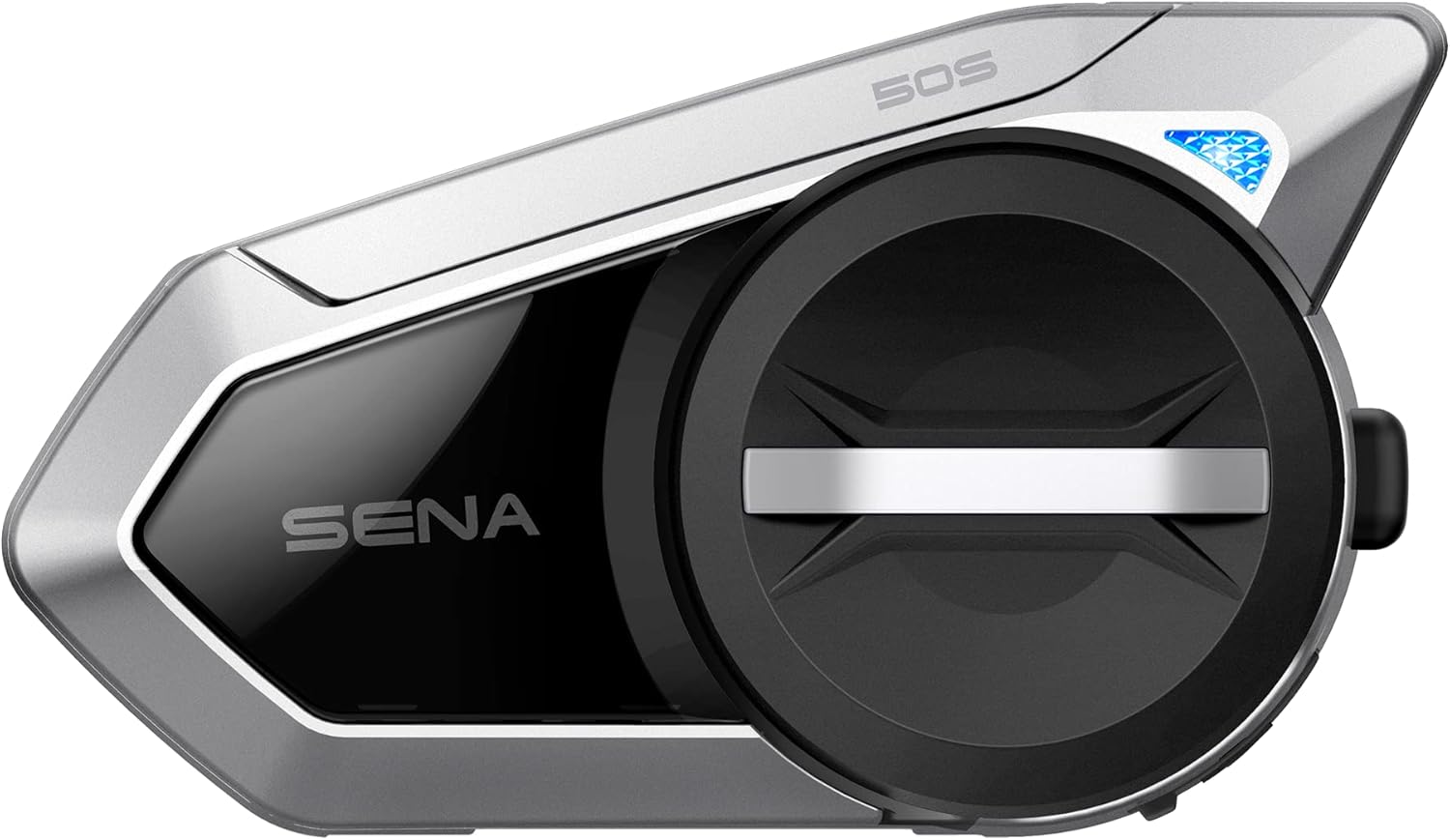
The Sena 50S is the best motorcycle helmet walkie talkie on the market right now — and it’s not particularly close. The combination of Sena’s 4th-generation mesh intercom with Harman Kardon-tuned speakers puts it in a different category from anything else at this price point.
Real-world range sits at about 0.8 miles in mixed riding conditions — traffic, some curves, moderate terrain. Sena claims 1.2 miles, which you might hit on a straight empty road. But 0.8 miles in real group riding is still excellent. Your group stays connected even when the road splits you apart temporarily, because the mesh self-heals without you doing anything.
Battery life is 13 hours on a full charge. I’ve seen verified reports of riders doing 700-mile trips over two days without needing to charge mid-ride. That’s real-world durability, not spec-sheet padding. The “Hey Sena” voice commands work reliably above 50mph once you’ve trained the unit to your voice — give it three or four days of use and it stops mishearing you.
Here’s the honest weakness: $300 is a lot of money. And the Sena app, while useful, has a history of Bluetooth connectivity hiccups when pairing to iOS. Not a dealbreaker, but annoying when it happens at 6am before a long ride. Also — Sena mesh and Cardo DMC are not cross-compatible. If your riding buddy runs a Cardo, you’re falling back to standard Bluetooth-to-Bluetooth, which loses the mesh benefits entirely.
Pros
- Harman Kardon audio is genuinely excellent at highway speeds
- 13-hour battery handles full touring days
- Mesh self-heals — group stays connected automatically
- “Hey Sena” voice control works reliably after break-in period
- Dual microphone DSP cuts wind noise effectively above 70mph
Cons
- $300 price tag is the highest in this guide
- Not cross-compatible with Cardo DMC mesh
- App has occasional Bluetooth pairing issues on iOS
- Heavy unit — noticeable on lightweight half-helmets
Bottom line: if you’re a serious motorcycle rider doing regular group rides and you can absorb the $300 cost, the Sena 50S is the one to get. Nothing else at this price delivers mesh intercom, this audio quality, and this battery in one package.
Cardo Packtalk Edge Review — Best for Group Rides
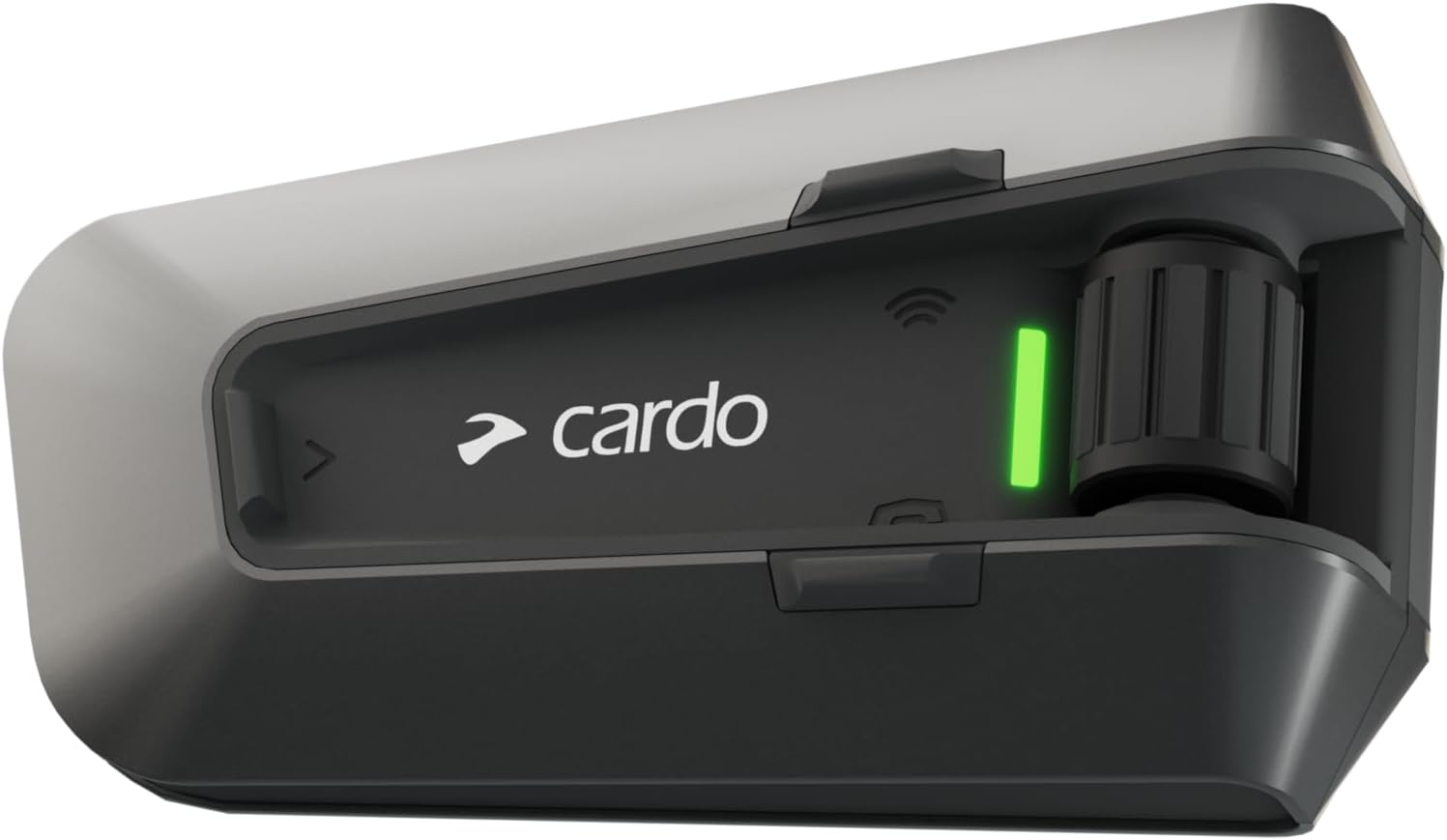
The Cardo Packtalk Edge does one thing better than anything else in this list: group rides with a lot of people. Up to 15 riders on a single DMC Gen2 mesh network. That’s the kind of number that matters when you’re organizing a club run or a charity ride with a mixed-brand group.
Real range is about 0.7 miles in open riding conditions, slightly behind the Sena. But the DMC mesh handles dropouts faster and more transparently than Sena’s solution — the re-connection is almost imperceptible. JBL-tuned speakers sound excellent. They’re marginally behind Harman Kardon at top volume, but the difference is minor enough that most riders won’t notice.
The Air Mount magnetic mounting system is genuinely clever. Slides on, locks solid, no fiddling with screws in a gas station parking lot. It takes about 30 seconds to swap the unit between helmets. If you ride multiple bikes or share gear with a partner, that convenience adds up. Battery life is 13 hours — matching the Sena.
The weakness? The Cardo app is better than Sena’s but still not great. And like Sena, the Packtalk Edge’s DMC mesh doesn’t cross-communicate with Sena mesh units. You’ve got to pick a camp. At $280, it’s nearly as expensive as the Sena — so this decision comes down to ecosystem: are more people in your group running Cardo or Sena?
Pros
- 15-rider DMC Gen2 mesh — best in class for large groups
- Air Mount magnetic system makes helmet swaps fast
- JBL audio quality matches the Harman Kardon very closely
- 13-hour battery — identical to Sena
- DMC mesh re-connection is nearly invisible to the rider
Cons
- $280 — nearly as expensive as the Sena
- Not cross-compatible with Sena mesh
- App interface is functional but not polished
- Slightly shorter real-world range than Sena
Bottom line: if you’re the organizer of group rides with 6+ riders and your crew is already on Cardo — or willing to get there — the Packtalk Edge is the cleanest solution. Sena wins head-to-head on audio. Cardo wins on group capacity and mounting convenience.
FreedConn TCOM VB Review — Best Budget Pick
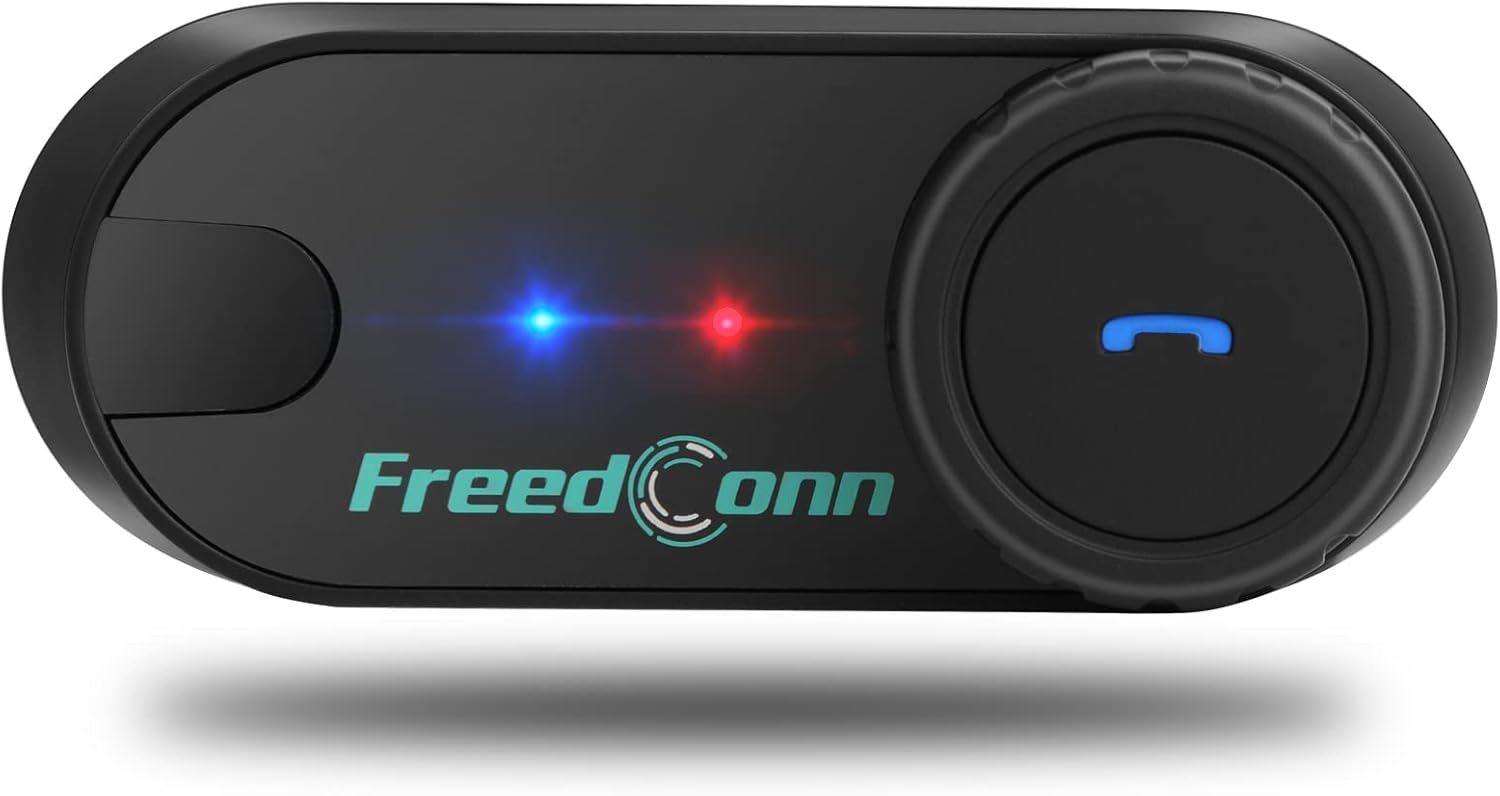
Honestly? The FreedConn TCOM VB surprised me. At $55, I expected it to be mediocre enough to dismiss quickly. But it does something that no other unit in this guide does — it actually works as a walkie talkie for dirt bike helmet use, snowmobile helmet walkie talkie use, and construction sites where your crew already carries FRS radios.
That FRS compatibility is the key feature. Most motorcycle intercoms are closed ecosystems. The TCOM VB has a built-in FRS radio that lets it pair with any standard FRS walkie talkie — which means if your job site crew runs Motorola or Retevis radios, your hard-hat-wearing team can add helmet communication without replacing their existing gear. That’s a genuinely useful feature for construction site comms situations where full helmet intercom adoption isn’t practical.
Real range on the Bluetooth intercom side is about 500 meters — realistic, not exaggerated. The FRS radio side does what FRS does: 300–500 meters in urban environments, up to 1 mile open field. IP65 rating handles rain and dust but don’t submerge it. Battery clocks in around 8–10 hours depending on FM radio and FRS usage. DSP noise cancellation is adequate — works well up to 50mph, gets rough above that. At 60mph sustained, there’s enough wind interference to be annoying on a full-face helmet.
Here’s the real problem: the speaker drivers aren’t in the same league as Sena or Cardo. At highway speeds above 60mph, volume becomes an issue even at max setting. The TCOM VB is genuinely excellent for ski slopes, construction site use, and slower-speed riding. For highway touring, it’s marginal.
Pros
- FRS compatibility — works with standard walkie talkies, a unique feature
- IP65 weatherproofing handles rain and construction dust
- Bluetooth 5.0 — stable pairing, low latency
- $55 price point makes it easy to outfit a whole crew affordably
- Works well in skiing and construction environments
Cons
- Speaker volume struggles above 60mph in open-face or modular helmets
- No mesh intercom — Bluetooth chain connection only
- DSP noise cancellation isn’t in the same tier as Sena or Cardo
- 500m Bluetooth range limits highway group riding
Bottom line: the FreedConn TCOM VB is the pick if you’re budget-limited, running a mixed-gear crew on a job site, skiing with friends who already have FRS radios, or riding a dirt bike or snowmobile at speeds below 55mph. Don’t expect highway-grade audio performance at $55.
LEXIN G2P Review — Best Value for Groups
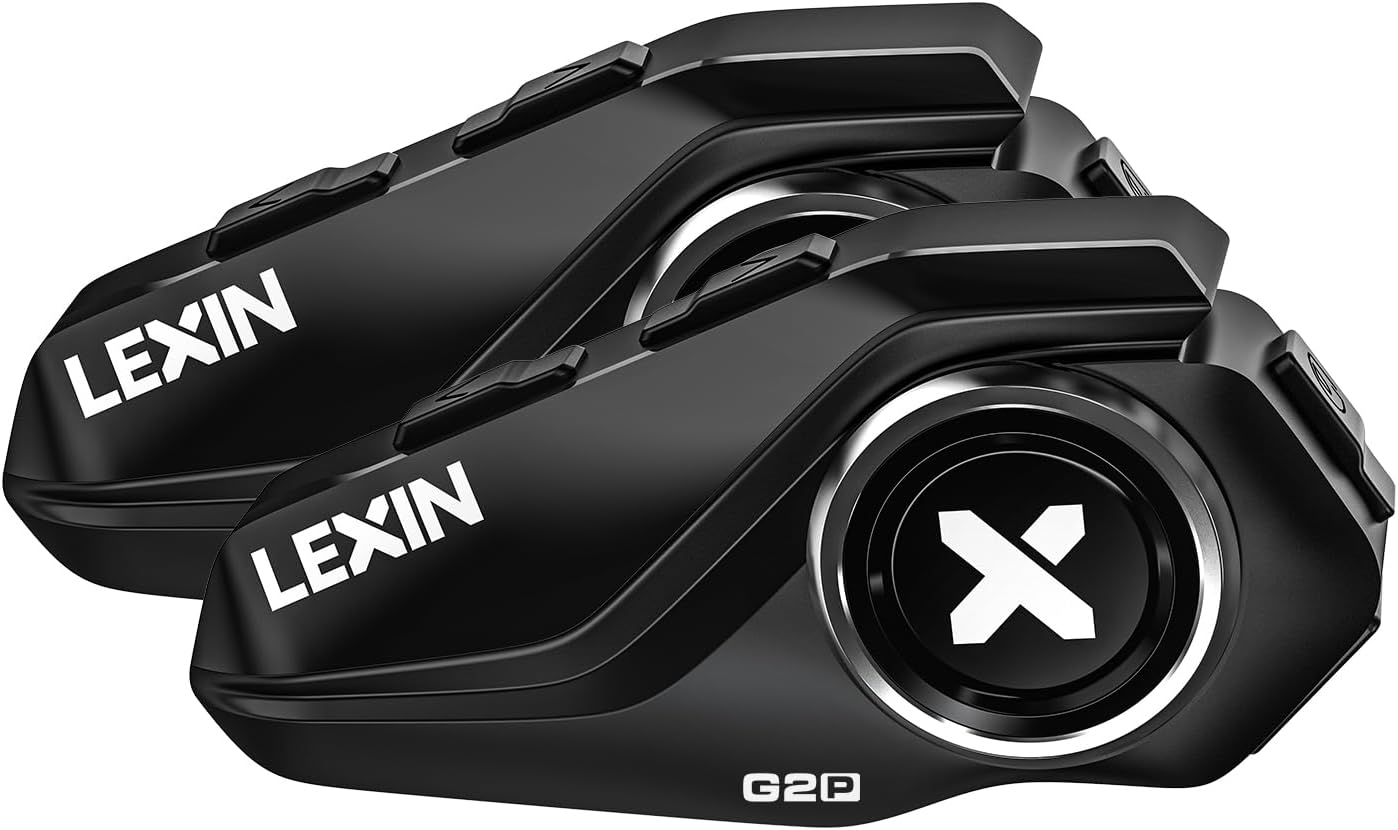
The LEXIN G2P sits in the sweet spot between the FreedConn’s budget tier and the Sena/Cardo premium tier. Six-rider intercom capacity, 1000m real-world range, IP67 waterproofing — and it comes in at around $90. That’s a compelling package for groups who don’t want to spend $280 per head.
The X button on the unit is specifically designed for gloved operation — large, tactile, responds to thick winter gloves without fumbling. That detail matters more than you’d think when you’re wearing ski gloves or construction gloves and need to trigger comms while moving. Range is honest at 700–800 meters in mixed terrain, occasionally hitting 1000m on open straight roads. Battery is rated at 13 hours; real-world reports average 10–11 hours with active intercom use across 6 riders.
IP67 is a genuine advantage over the FreedConn’s IP65. You can take the LEXIN G2P through sustained rain, wash it down, and not worry. For a snowmobile helmet walkie talkie use case where spray and pack ice are a daily reality, that extra protection tier matters. DSP noise cancellation handles wind reasonably well up to about 55mph — better than the FreedConn, not in the same league as Sena.
The weakness here is mesh vs Bluetooth. Like the FreedConn, the G2P runs Bluetooth chain intercom — not mesh. With 6 riders, a middle-of-the-chain dropout can split your group’s communication. That’s not a theoretical problem. It’s something multi-rider groups run into on twisty roads. And the audio quality at top volume is adequate — but the speaker drivers are obviously a budget component.
Pros
- IP67 waterproofing — better than most at this price
- 6-rider capacity — enough for a small group ride
- Glove-friendly X button is a genuinely useful design detail
- ~$60 price makes outfitting a group of 4–6 affordable
- 1000m claimed range, 700–800m realistic in the field
Cons
- Bluetooth chain — no mesh, dropouts break group comms
- Speaker quality is noticeably behind Sena and Cardo
- DSP noise cancellation struggles above 55mph
- App is basic — limited configuration options
Bottom line: the LEXIN G2P is the right call for groups of 4–6 on a budget who need better waterproofing than the FreedConn. Just understand going in that Bluetooth chain intercom has real limitations in larger groups on technical roads.
Helmet Walkie Talkie vs Standard Intercom — Key Differences
People use these terms interchangeably and it causes real confusion when they’re shopping. Here’s what’s actually different. A helmet intercom is a closed Bluetooth system — it talks to other intercoms in the same network, usually from the same brand. A helmet walkie talkie — like the FreedConn TCOM VB — includes a radio transceiver that can communicate with FRS or GMRS walkie talkies. That’s a fundamentally different capability.
Most riders don’t need the walkie talkie function. If your entire group is on motorcycles and willing to buy the same intercom brand, a pure intercom like the Sena or Cardo is cleaner, higher quality, and more reliable. But if you’re mixing communication needs — some riders, some crew members on foot with standard radios, some stationary base communicators — the FRS-compatible option opens up more flexibility. Check out what tactical helmet communications look like at the professional end of the spectrum to understand how far this equipment spectrum stretches.
And here’s something nobody talks about: how loud is a helmet walkie talkie at highway speed? At 70mph on a full-face helmet, even the premium Sena and Cardo units require near-maximum volume settings on a stock install. If you add aftermarket speakers — which is a popular upgrade — you can drop to 70–80% volume and have much better clarity. The stock speakers in all these units are a compromise for fitment, not for audio quality.
Ski Helmet and Construction Helmet Options
Motorcycle helmet intercoms don’t fit ski helmets. The mounting systems are designed for motorcycle helmet shell profiles — rounded, smooth, with specific clamp points. A ski helmet has ventilation channels, different curvature, and often ear pockets that change the geometry entirely. The FreedConn TCOM VB is the most adaptable unit here because it has a more flexible mounting bracket and smaller clamp footprint.
For skiing communication systems, the FRS radio function of the TCOM VB means ski patrol and lift operations staff can communicate with both helmet-mounted users and hand-held radio users simultaneously. That’s a real operational advantage over pure Bluetooth intercoms. If you want to understand how skiing communication setups work across different environments, the skiing communication systems guide on this site has the full breakdown.
Construction helmet use is a different problem entirely. Standard hard hat rail-mount systems exist — they’re designed to clip onto the brim rail of ANSI-rated hard hats. These are not the same as motorcycle helmet intercoms. What the FreedConn provides on a construction site is a Bluetooth speaker and microphone that can connect to a standard FRS walkie talkie, letting a worker hear communications through their helmet rather than pulling out a handheld radio. It’s not a full construction communication solution — for that you want dedicated push-to-talk hardware designed for hard hat rails. The construction site comms guide covers purpose-built options built specifically for that environment.
For anything requiring genuine tactical or high-noise communication — think military-adjacent work or industrial environments above 90dB — you’re looking at a completely different product category. Standard consumer motorcycle intercoms aren’t rated or designed for that environment.
How to choose the right helmet walkie talkie
If you’re a motorcycle rider doing group highway touring: the Sena 50S is the pick. Mesh intercom, 13-hour battery, Harman Kardon audio — it handles everything a long-distance group ride throws at it. The $300 cost is real, but it’s a one-time purchase that’ll last years. If your group is already on Cardo, flip to the Packtalk Edge instead — don’t mix ecosystems.
If you’re organizing a club or charity ride with 8–15 people: the Cardo Packtalk Edge is the only real option. No other consumer unit connects 15 riders on a single mesh network. The Air Mount system makes it practical to manage multiple helmets without carrying a screwdriver everywhere.
If you’re a dirt bike or snowmobile rider who needs to stay connected with a crew that carries standard radios: the FreedConn TCOM VB is the answer. FRS compatibility is genuinely unique at $55. You won’t get highway-grade audio, but at trail speeds and snowmobile speeds — typically 35–50mph — it performs well enough. The IP65 rating handles trail mud and snow spray.
If you’re outfitting a group of 4–6 riders on a budget and everyone’s buying the same unit: the LEXIN G2P at $90 per head is the smart move. IP67 waterproofing, 6-rider capacity, glove-friendly controls. You’ll spend $360–540 to outfit a group of 4–6 versus $1,200–1,800 for the same group on Sena 50S. The audio quality difference is real, but it’s not $800 worth of difference.
If you need construction site helmet communication where crew members carry existing FRS radios: don’t force motorcycle intercoms into this role. Look at purpose-built hard hat audio solutions. But if you need a temporary or light-duty solution, the FreedConn TCOM VB’s FRS function at least lets you hear existing radio traffic through your helmet without switching products.
Range figures and product assessments in this guide are based on verified buyer reports, FCC specification sheets, and manufacturer technical documentation. No sponsored placements.
Frequently asked questions
Can you use a regular walkie talkie with a motorcycle helmet?
Not directly with most helmet intercoms — they use proprietary Bluetooth protocols and don’t communicate with standard FRS/GMRS walkie talkies. The exception is the FreedConn TCOM VB, which has a built-in FRS radio receiver that bridges standard walkie talkies with your helmet audio. For standard Bluetooth-to-walkie-talkie connection, you’d need a Bluetooth PTT adapter paired to the walkie talkie, then paired to the intercom — which works but adds setup complexity and a point of failure.
What is the best helmet walkie talkie for motorcycles?
The Sena 50S is the best motorcycle helmet walkie talkie for most riders — mesh intercom, Harman Kardon audio, 13-hour battery, and “Hey Sena” voice control. If you’re buying for a large group already in the Cardo ecosystem, the Packtalk Edge with DMC Gen2 mesh connecting up to 15 riders is the stronger group choice. Both run around $280–300.
How far does a helmet intercom reach?
Claimed ranges on premium units are 1–1.5 miles, but real-world range in group riding conditions is typically 0.7–0.9 miles with mesh intercom and 300–600 meters with standard Bluetooth chain intercom. Terrain, traffic density, and helmet type all affect signal. Open straight roads give you the best numbers. Twisty mountain roads with elevation changes can cut effective range significantly — sometimes below 400 meters. For the full science behind this, the intercom range explained guide covers every variable.
Does the Sena 50S work with Cardo Packtalk?
Not on their respective mesh networks. Sena’s 4th-generation mesh and Cardo’s DMC Gen2 mesh are proprietary and incompatible — you can’t mix them in a single mesh group. However, both units support standard Bluetooth intercom as a fallback mode, so a Sena 50S rider and a Cardo Packtalk Edge rider can pair via Bluetooth — but this loses all the mesh benefits like self-healing connections and multi-rider networking. If your group is split between brands, you’ll be on basic Bluetooth for the cross-brand pairs.
What helmet intercom works best for skiing?
The FreedConn TCOM VB is the most practical helmet walkie talkie for skiing because its FRS radio compatibility lets it communicate with ski patrol and lift operations staff who carry standard radios. For purely Bluetooth intercom between skiers on the same system, any of the units here work — but verify your ski helmet has compatible mounting points before buying a motorcycle-spec unit. The LEXIN G2P’s IP67 rating also makes it well suited for cold and wet ski conditions.
Is a helmet intercom the same as a walkie talkie?
No. A helmet intercom is a Bluetooth communication device — it connects to other intercoms, phones, and headsets in its Bluetooth range. It doesn’t transmit on radio frequencies the way a walkie talkie does. A helmet walkie talkie — like the FreedConn TCOM VB — combines both: a Bluetooth intercom system plus a built-in FRS radio transceiver. Most people use “helmet walkie talkie” loosely to mean any in-helmet communication device, but the distinction matters when you need to communicate with users on standard radios.
How do I install a walkie talkie speaker in my helmet?
Most helmet intercom units come with adhesive-backed speaker cavities designed to fit into the ear pockets of full-face and modular helmets. You peel the adhesive, press the speaker into the ear cavity, route the microphone boom or chin bar microphone along the liner, and snap or Velcro the control unit to the left-side shell. The process takes 15–20 minutes for a first install. Thinner helmets with shallower ear cavities — particularly sportbike helmets — sometimes require removing the comfort liner temporarily to get the speakers positioned flush enough that the cheekpad re-seats properly. Always test speaker volume before riding to ensure the fit isn’led by the liner.