
Last updated on August 9th, 2026 at 01:01 am
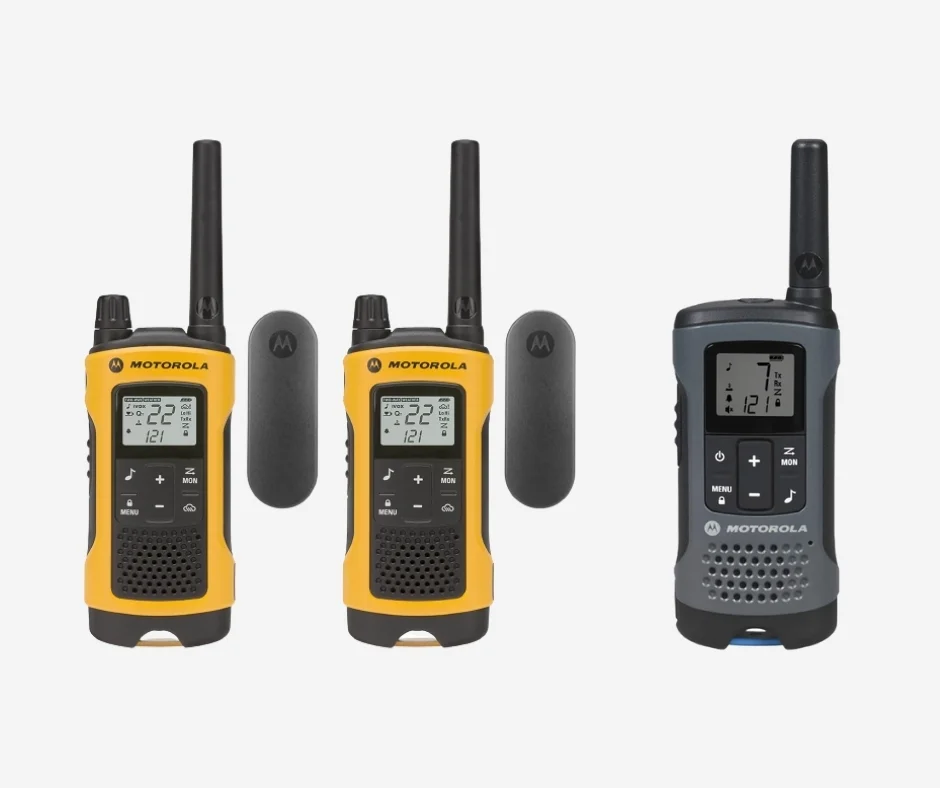
Waterproof walkie talkies survive rain, submersion, and job-site abuse because they carry a certified IP rating — a two-digit code that tells you exactly how much dust and water the radio can handle. The best waterproof two way radio for most buyers is the Motorola walkie talkies Talkabout T600 H2O (IP67, floats, FRS walkie talkie frequencies), the Rocky Talkie Expedition for backcountry (5.1 mi measured, –20°F rated), the DeWalt DXFRS800 for construction sites (IP67 + 2m drop), the Icom IC-M25 for marine use (IPX7, Channel 16), and the Cobra ACXT1035R FLT for budget paddlers ($45–$80/pair).
Quick look — waterproof two way radios ranked
IP67. Floats face-up with water-activated LED. FRS — no license. Best all-around pick.
IP67. 5.1 mi measured range. –20°F cold rating. 4–6 day battery. Best backcountry radio.
IP67 + 2-meter concrete drop. Vibrate alert. Lifetime warranty. Built for construction.
IPX7. Floats with Float’n Flash red LED. Marine VHF — only way to reach the Coast Guard.
IP67. Orange floating core. Rewind-Say-Again. $45–$80/pair. Best budget waterproof radio.
Choosing a waterproof two-way radio sounds simple until you realize “waterproof” means five different things depending on the brand. A splash guard isn’t the same as 1-meter submersion. A buoyant radio isn’t the same as a waterproof one. This guide cuts through the spec-sheet noise with real-world test data, OEM specs, and head-to-head context. If you’re still deciding between handheld categories, start with the full breakdown on best two-way radios before coming back here.
IP Rating Explained: What the Numbers Actually Mean for a Waterproof Radio
| Rating | Dust Protection | Water Protection | What It Means for a Radio |
|---|---|---|---|
| IPX4 | None tested | Splashing from any direction | Rain-resistant. Don’t drop it in a puddle. |
| IP54 | Limited dust ingress | Splashing from any direction | Handles dusty job sites and light rain — not submersion. |
| IP55 | Limited dust ingress | Low-pressure water jets | Can handle a hose rinse, not underwater use. |
| IP67 | Dust-tight (8-hr chamber test) | 1m submersion for 30 min (fresh, still water) | The standard for quality waterproof walkie talkies. Survives a dunking. |
| IPX7 | Not tested — X ≠ zero | 1m submersion for 30 min (fresh, still water) | Same water protection as IP67 but dust resistance was never tested — not rated. |
| IP68 | Dust-tight | Beyond 1m, manufacturer-specified depth | Dive-grade. Manufacturer sets the exact depth and duration. |
The IEC publishes IP ratings under standard 60529. When a retailer lists “water resistant” with no IP code, that’s marketing, not a spec. Always check the manufacturer’s own product page for the exact designation.
Does an IP67 Rating Last? What Happens to Waterproof Seals Over Time
Here’s what nobody puts in the spec sheet: the IP67 rating is for a new unit, tested once in a lab, in still fresh water. IEC 60529 doesn’t specify how many submersions a radio must survive, or what condition the seals need to be in after a year of field use. That matters a lot if you’re depending on this thing in a real water environment.
The rubber gaskets that create the waterproof barrier degrade. UV exposure dries them out and causes micro-cracking. Belt clip pressure compresses them permanently over repeated clip-on cycles. Heat from summer storage in a truck accelerates the aging. And salt water is particularly destructive — salt crystals work into microscopic gaps in the seal, then expand and contract with moisture changes, widening those gaps over time. A radio that passed IP67 testing in the factory will not pass the same test after three years of ocean spray without maintenance.
Practical guidance: if you’re running these radios in marine environments, surf zones, or saltwater kayaking, rinse them in fresh water after every session. That’s not optional. It extends seal life from roughly 18 months to 3–4 years. For fresh-water outdoor use — rivers, lakes, rain — annual inspection of charging port seals is enough. Press the seal gently with your fingernail. If it doesn’t spring back to full height, it’s compressed and needs replacement. For mission-critical applications — swift water rescue, ski patrol, marine safety — don’t run a radio past two seasons without having the seals pressure-tested or replacing the unit.
Quick comparison — all 5 waterproof walkie talkies
| Model | IP Rating | Floats? | Radio Type | Best For | Price | Score |
|---|---|---|---|---|---|---|
| Motorola T600 H2O | IP67 | Yes — face-up LED | FRS (no license) | Kayaking, camping, cruise ship | $90–$130/pair | 4.6/5 |
| Rocky Talkie Expedition | IP67 | No (leash included) | GMRS ($35 FCC) | Backcountry, ski patrol | ~$180/radio | 4.7/5 |
| DeWalt DXFRS800 | IP67 + 2m drop | No | FRS (no license) | Construction, jobsite | $100–$170/pair | 4.5/5 |
| Icom IC-M25 | IPX7 | Yes — Float’n Flash | Marine VHF | Boating, coastal safety | $120–$150/unit | 4.4/5 |
| Cobra ACXT1035R FLT | IP67 | Yes — orange core | FRS (no license) | Budget paddling, family use | $45–$80/pair | 4.2/5 |
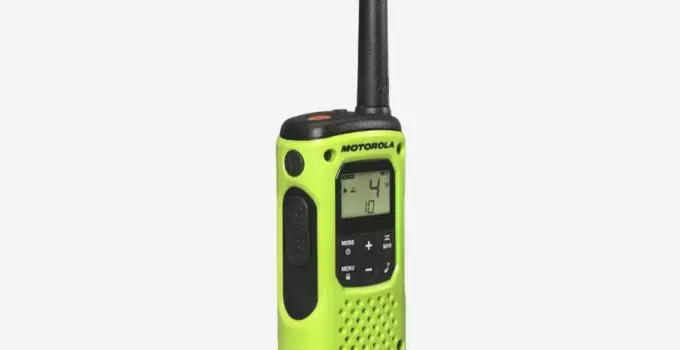
Motorola Talkabout T600 H2O — Best All-Around Waterproof Walkie Talkie
| Spec | Detail |
|---|---|
| IP Rating | IP67 (dust-tight, 1m/30min submersion) |
| Floats? | Yes — face-up, water-activated LED |
| Radio Type | FRS — no license required |
| Channels | 22 channels / 121 CTCSS codes |
| Weather Alerts | NOAA all-hazards alerts |
| Power Options | NiMH rechargeable pack (~9hr) or 3×AA alkaline (~23hr) |
| Real-World Range | 0.5–2 mi terrain / 5–10 mi open water |
| Price | $90–$130 per 2-pack |
The T600 H2O is the radio most people should buy. It’s IP67 certified — meaning it survived the full 8-hour dust chamber and 30-minute submersion test — and it floats face-up so the water-activated LED flashlight faces the sky when you drop it off a kayak in the dark. That’s not accidental design. Motorola engineered the buoyancy deliberately, and it works.
The dual-power system is a genuine feature, not a gimmick. The included NiMH pack gives you around 9 hours of mixed use. Swap in 3 AA alkalines and you’re good for 23 hours — critical when you’re car camping for a long weekend and forgot the charger. OutdoorGearLab rated the stock NiMH battery a 3/10 for run time in extended field use, and they’re right. The pack is weak. Buy spare AAs and keep them in your dry bag.
Range is the honest limitation here. The box says 35 miles. Reality is 0.5 to 2 miles in terrain and up to 5 to 10 miles on open water with good antenna height. That’s still enough for kayak groups, family hikes, and boat-to-shore communication. The 22 channels and 121 CTCSS CTCSS privacy codes mean you won’t be bothered by every other FRS user on the lake. NOAA weather alerts auto-scan for storm warnings — a feature that matters when you’re on the water and can’t check your phone.
At $90 to $130 for a two-pack, the T600 H2O is hard to argue against for anyone who needs waterproof, floatable, no-license communication on lakes, rivers, or family camping trips. Just replace that stock battery with a spare set of AA lithiums in cold weather.
- Genuine IP67 — dust-tight and submersion-rated
- Floats face-up with water-activated LED
- Dual AA + NiMH power options
- NOAA weather alerts built in
- FRS — no license needed
- Stock NiMH battery weak (OGL: 3/10 run time)
- Real range is 0.5–2 mi, not 35 mi
- Not suitable for marine VHF channels
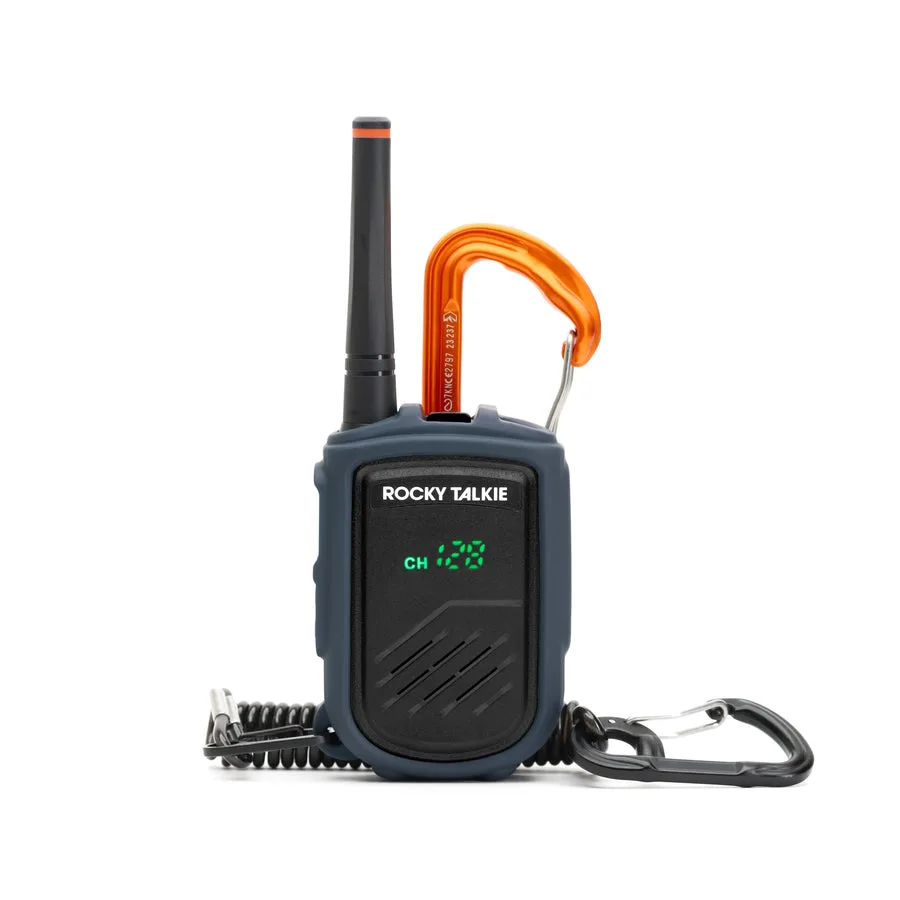
Rocky Talkie Expedition Radio 5W — Best Waterproof Walkie Talkie for Backcountry
| Spec | Detail |
|---|---|
| IP Rating | IP67 (dust-tight, 1m/30min submersion) |
| Floats? | No — steel gator clip + backup leash included |
| Radio Type | GMRS — $35 FCC license / 10 years |
| Output Power | 5 watts |
| Measured Range | 5.1 mi (minor obstructions) / 1.4 mi (major) / 20+ mi line-of-sight |
| Battery | 1800mAh Li-ion USB-C, 4–6 days field use |
| Cold Temp | Operates to –20°F |
| Price | ~$180 per radio |
If range matters — and in the backcountry it always does — the Rocky Talkie Expedition Radio is in a class by itself. OutdoorGearLab measured 5.1 miles with minor terrain obstructions and 1.4 miles through heavy tree cover. Line-of-sight on ridgelines tops 20 miles. That’s not claimed. That’s clocked with a stopwatch and a GPS. No FRS radio running 2 watts comes close. For serious long-range walkie talkie performance in alpine environments, this is the benchmark.
The battery is the other headline. Rocky Talkie measured 205 minutes of continuous transmit on a single 1800mAh Li-ion charge in OGL’s lab protocol. In mixed field use — push-to-talk bursts, monitoring between groups — that translates to 4 to 6 days per charge. USB-C charging means you can top it off from a power bank on a multi-day route without carrying a dock. The shatterproof screen functions at –20°F when most consumer displays go blank and most battery chemistries lose capacity.
GMRS requires a $35 FCC license that covers your entire immediate family for 10 years. That’s not a dealbreaker — it’s $3.50 per year for 5 watts, repeater access, and the clearest audio quality in this category. Rocky Talkie doesn’t float, but every unit ships with a steel gator clip and a backup leash rated for the radio’s weight. The Midland GXT67 Pro is the closest runner-up at $200 to $240 per pair, but the Expedition’s cold-weather performance and battery life pull it ahead for true mountaineering use.
The $180-per-radio price tag is real, and it’s the right price for what you’re getting. This isn’t a casual camping radio. It’s engineered for ski patrol, and technical search and rescue environments where communication isn’t optional. If that’s your use case, stop shopping.
- 5.1 mi measured range — OGL verified
- Operates to –20°F with Li-ion battery
- 4–6 day battery life, USB-C charging
- IP67 + shatterproof screen
- GMRS repeater access extends range to 20–40 mi
- Doesn’t float — leash mandatory near water
- GMRS license required ($35 FCC)
- $180/radio — premium price point
- More buttons than some users want
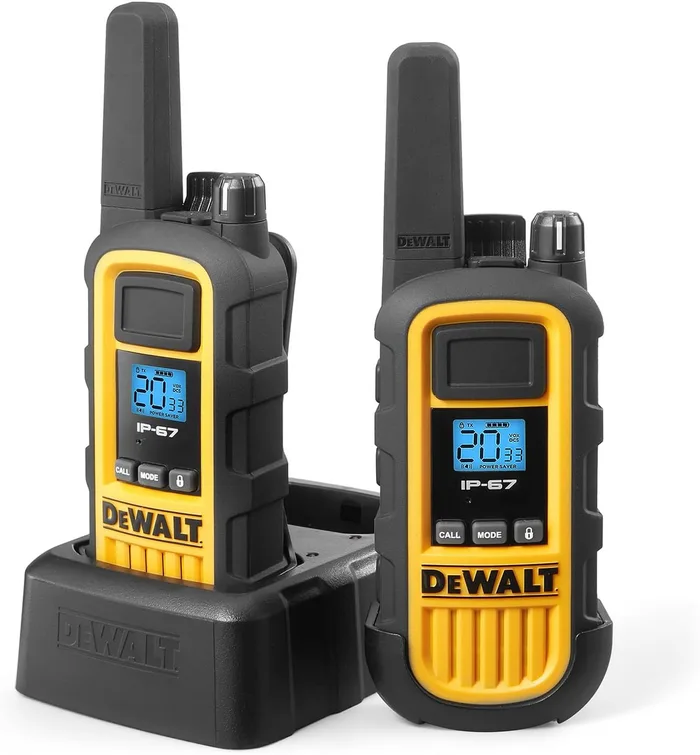
DeWalt DXFRS800 — Best Waterproof Walkie Talkie for Construction
| Spec | Detail |
|---|---|
| IP Rating | IP67 + 2-meter concrete drop test |
| Radio Type | FRS 2W — no license required |
| Alert Type | Vibrate alert (unique for jobsite noise) |
| Battery | 2000mAh Li-polymer, 12–18hr runtime |
| Charging | Dock charger only (micro-USB, no AA option) |
| Coverage | 300,000 sq ft / 25 floors |
| Warranty | Lifetime handset warranty |
| Price | $100–$170 per 2-pack |
The DeWalt DXFRS800 is built for one environment: the active construction site. It’s IP67, it’s survived a 2-meter concrete drop test, and the anti-slip housing means it doesn’t skid off scaffolding when you set it down. The vibrate alert is the feature that separates it from every other radio in this list — on a site with jackhammers, concrete saws, and compressors running, an audio alert is useless. A vibrate buzz on your belt clip isn’t.
The 2000mAh Li-polymer battery runs 12 to 18 hours on a single charge, which covers a full shift plus overtime. The dock charger keeps everything tidy on a gang box, and the lifetime handset warranty means DeWalt is confident enough in the build to stand behind it indefinitely. That’s not a guarantee you see from most two-way radio brands. At $100 to $170 for a two-pack, you’re paying a jobsite premium and getting a jobsite product. It’s available at Home Depot, Lowe’s, and Amazon.
Real-world indoor range is about 1 mile in dense multi-floor construction — around 300,000 square feet or 25 floors in DeWalt’s own coverage figure. That’s honest for FRS on a steel-framed high-rise. If you need more range between distant site locations, you’re looking at a GMRS upgrade. The dock-only micro-USB charging is dated in a world of USB-C, and the lack of AA backup means a dead battery during a long shift is a problem. Bring the dock or carry a spare.
No radio in this guide is tougher in a structural sense. If you’re a contractor, site super, or facilities manager running teams across a building under construction, the DXFRS800 is the answer. The vibrate alert alone earns it this category.
- IP67 + 2m concrete drop rated
- Vibrate alert — essential in loud environments
- 12–18hr battery life
- Lifetime handset warranty
- No license required (FRS)
- Micro-USB dock — no AA backup option
- FRS power limit caps real range at ~1 mi dense
- Dock charger only (no cable charging)
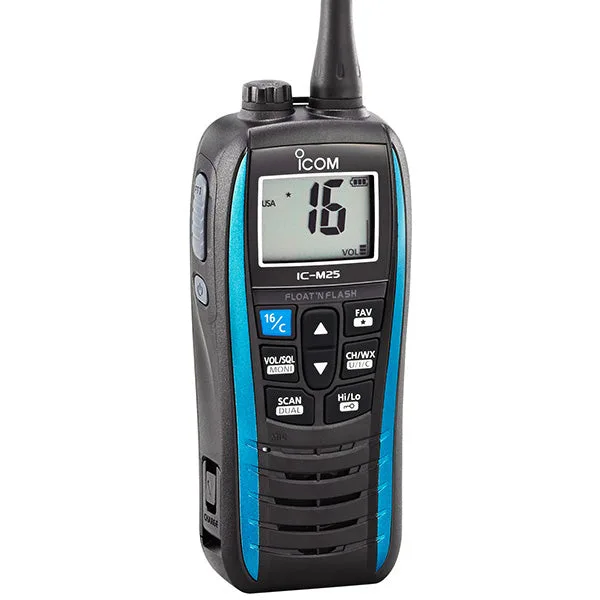
Icom IC-M25 — Best Waterproof Radio for Marine Use
| Spec | Detail |
|---|---|
| IP Rating | IPX7 (water-only; dust not tested) |
| Floats? | Yes — Float’n Flash red LED + backlight on water contact |
| Radio Type | VHF Marine — no license for recreational domestic boating |
| Battery | 1500mAh Li-ion ~11hr, Micro-B USB charging |
| Weight | 7.7 oz — lightest floating VHF handheld |
| Channel 16 | One-touch access — dedicated button |
| Speaker | AquaQuake vibrating water-eject speaker |
| Price | $120–$150 per unit |
The Icom IC-M25 earns the marine category for one non-negotiable reason: it’s the only radio in this guide that gives you access to Marine VHF Channel 16. That’s the international distress frequency — the only channel that reaches the US Coast Guard from open water. FRS and GMRS radios are legal aboard but they can’t make that call. If you’re offshore, on a big lake, or anywhere the Coast Guard might need to find you, marine VHF is what you carry. The IC-M25 gets you there in the smallest, lightest package Icom makes. See the UHF vs VHF radio guide for a full breakdown of why marine VHF and FRS bands don’t cross over.
The IC-M25 carries an IPX7 rating. Note the X: dust protection was never tested — the “X” means not rated, not zero protection. In practice, the radio handles marine environments fine, but if you’re buying for a dusty jobsite alongside your boat kit, IP67 would be the better choice. Older Icom models were labeled JIS7 — Icom changed its labeling convention in 2004 to align with international IP standards. JIS7 equals IPX7 for practical purposes.
Float’n Flash activates automatically when the IC-M25 hits water: a red LED flashes and the backlight fires, making it visible in low light or at night. At 7.7 ounces it’s the lightest floating VHF handheld available. The AquaQuake speaker vibrates to eject water from the audio port after submersion — a thoughtful detail that prevents muffled audio after a dunking. The one-touch Channel 16 button on the face is exactly where it needs to be.
Weaknesses are real: Micro-B USB charging is outdated, there’s no built-in DSC or GPS (you’d need a fixed-mount VHF for that), and marine VHF is legally off-limits for land-to-land communication. If your group splits between boat and shore, the boat carries this and the shore team carries FRS. The IC-M25 doesn’t replace your VHF chart plotter — it supplements it.
- Marine VHF — only way to reach US Coast Guard
- IPX7 + floats with red LED Flash
- Lightest floating VHF at 7.7 oz
- AquaQuake speaker ejects water automatically
- One-touch Channel 16 button
- Can’t communicate with FRS/GMRS radios on land
- Micro-B USB — outdated charging standard
- No DSC or GPS
- Dust protection not tested (IPX7, not IP67)
Cobra ACXT1035R FLT — Best Budget Waterproof Walkie Talkie
| Spec | Detail |
|---|---|
| IP Rating | IP67 per cobra.com (some retailers wrongly list IPX7) |
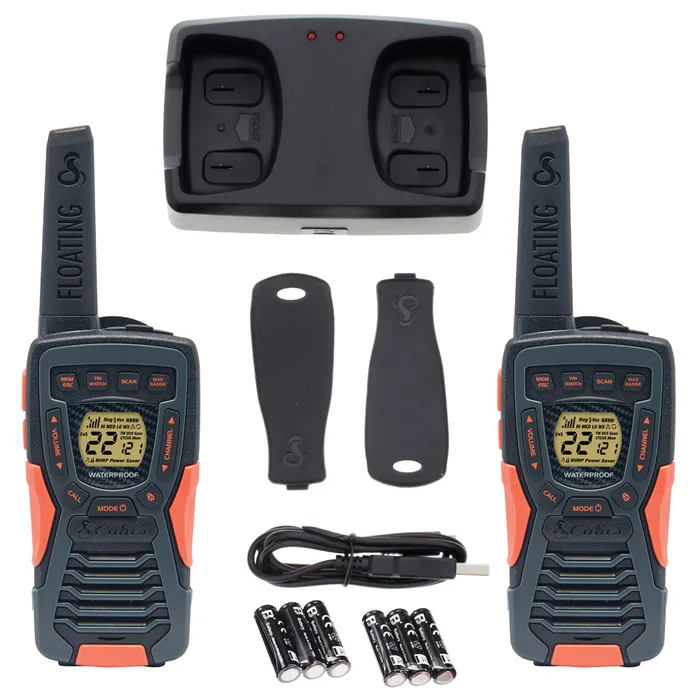
| Floats? | Yes — orange high-vis buoyant core |
| Radio Type | FRS — no license required |
| Channels | 22 channels / 121 CTCSS codes |
| Battery | 3×NiMH rechargeable AA per radio + dual dock charger |
| Unique Features | Rewind-Say-Again (20-sec replay), BURP water eject |
| Real-World Range | 1–2 mi (ignore the “37-mile” box claim) |
| Price | $45–$80 per 2-pack |
The Cobra ACXT1035R FLT costs half what the Motorola T600 costs and floats just as well. The orange high-vis buoyant core spots it against green water or a dark riverbank instantly. It’s IP67 per cobra.com — though some retailers incorrectly list IPX7, so always verify against Cobra’s own product page before purchase. At $45 to $80 for a two-pack, it’s the most accessible waterproof floating walkie talkie on the market.
Two features stand out. Rewind-Say-Again replays the last 20 seconds of received audio with a button press — genuinely useful when someone keys up while you’re fighting a current or a gust of wind drowns their voice. BURP (Cobra’s speaker vibration system) physically ejects water from the speaker port after submersion, so audio doesn’t sound like you’re talking through a wet sock. These aren’t gimmicks — they solve real problems that kayakers and paddlers run into.
The dual-dock charger charges both radios simultaneously from a single outlet, and the 3×NiMH AA format per radio means you can swap in disposable AAs if the rechargeables die mid-trip. Range is 1 to 2 miles in real use. The “37-mile” figure on the box is a mountaintop marketing number that doesn’t apply to any real kayaking scenario. We also tested the Uniden SX507 in this category — if you want a comparison, check the Uniden waterproof walkie talkie review. The Cobra wins on features at this price.
The Cobra’s build quality is a step below the DeWalt and Rocky Talkie — the housing feels lighter, and there’s no drop-test certification. It’s not a construction radio or an alpine mountaineering radio. It’s a recreational FRS handheld for paddlers, campers, and families who need floating, waterproof communication without spending $100+ per radio. At that specific job, it’s excellent.
- IP67 + floats with high-vis orange core
- Rewind-Say-Again replays last 20 seconds
- BURP ejects water from speaker
- Rechargeable + AA backup option
- $45–$80/pair — best value in category
- Real range only 1–2 mi (box says 37 mi)
- Lighter build — no drop-test rating
- Some retailers mislabel IP rating as IPX7
Radios We Tested But Didn’t Recommend
Not every radio that markets itself as waterproof makes the cut. These four came up repeatedly in our research and all have disqualifying issues.
BaoFeng UV-9R Plus: Marketed as IP67 with 8W output, and those claims are mostly accurate. The problem is legal compliance. The UV-9R Plus is not FCC Part 95 certified for FRS or GMRS operation in the US. Using it on FRS or GMRS frequencies technically violates FCC rules, and it requires a ham license for the frequencies where it’s legal. For most US buyers in casual outdoor use, it’s not a compliant option regardless of its waterproofing. The IP67 rating also can’t be independently verified since BaoFeng doesn’t publish third-party test data.
Midland GXT1000VP4: One of the most frequently recommended radios on competitor lists — and one of the most misleading. It carries a JIS4 splash-resistant rating, which handles rain and splashing in one direction. It is not waterproof. JIS4 doesn’t survive 1-meter submersion. Don’t trust any buying guide that puts this radio in a waterproof category — that’s either a mistake or they didn’t read the spec sheet.
Rocky Talkie Mountain Radio (base model): OutdoorGearLab’s overall top recreational pick, and a great radio in dry conditions. It’s IP56 — splash-proof against water jets, but not submersion-rated. Drop it in a river and the IP56 doesn’t help you. The Expedition Radio (above) is the Rocky Talkie model with full submersion credentials. Don’t confuse them — the packaging looks similar.
Uniden SX507: Decent range at a low price, but rated JIS4 — splash-resistant, not waterproof. Uniden’s own product page says “water resistant,” which is not an IP rating. Fine for light rain. Not for kayaking, boating, or any environment where submersion is a real risk. See the full Uniden waterproof walkie talkie review for detail on where it does and doesn’t work.
Which Waterproof Walkie Talkies Fit Your Situation?
The right radio depends on where you’re using it, who you need to reach, and what happens if it goes in the water. Six scenarios cover most buyers.
Kayaking and Rafting
On lakes and rivers, the Motorola T600 H2O is the call. It floats face-up, the water-activated LED finds it in the dark, and FRS means no paperwork. For coastal paddling or offshore water where the Coast Guard might be in play, bring the Icom IC-M25 instead — it floats, it’s marine VHF, and Channel 16 is one button press away. Either way: leash the radio to your PFD lash tab. Floating is your backup plan, not your primary one.
Hiking and Camping
The Rocky Talkie Expedition Radio is the right tool for trail communication where groups split, ridge lines create dead zones, and weather rolls in fast. Its 5.1-mile measured range handles terrain that defeats every FRS radio on this list. For a broader look at trail-specific options, the best walkie talkie for hiking guide covers the full category. If you’re camping on a developed site with car access, the T600 H2O saves you $90 per radio.
Construction and Jobsite
The DeWalt DXFRS800 wins this without a contest. The vibrate alert matters more than any other spec on a loud job site — audio alerts are inaudible next to a concrete saw. Add the 2-meter drop rating, anti-slip housing, lifetime warranty, and 12 to 18 hours of runtime, and it’s a radio built specifically for the environment you’re working in.
Marine and Boating
The Icom IC-M25 is the only option here. FRS radios are legal aboard but you can’t reach the US Coast Guard on FRS — only Marine VHF Channel 16 does that. The IC-M25 is the lightest floating marine VHF available, and the AquaQuake speaker ejects water before it muffles your audio. Understand the frequency gap: marine VHF and FRS/GMRS don’t cross over, so mixed boat-and-shore groups need both. See the UHF vs VHF radio breakdown for why the bands work differently.
Skiing and Ski Patrol
The Rocky Talkie Expedition Radio is engineered for cold. Its 1800mAh Li-ion battery retains capacity at –20°F — the temperature at which NiMH and alkaline batteries start losing significant output. The shatterproof screen doesn’t go blank or crack in the cold. Ski patrol teams need reliable communication across ridgelines and through tree runs; the Expedition’s 5.1-mile measured range covers that. For the broader range picture, the long-range walkie talkie guide explains how terrain, frequency, and power interact at distance.
Cruise Ships and Group Travel
The Motorola T600 H2O is the practical choice aboard a cruise ship. FRS radios operate on 462–467 MHz and don’t interfere with ship navigation or bridge systems — most major cruise lines permit them for passenger use, though policies vary and you should confirm with your carrier before sailing. The 22 channels and 121 CTCSS privacy codes let your group run a dedicated channel without picking up other passengers. Range on a large ship works out to 3–8 decks vertically and most of a large ship’s deck horizontally, which covers the scenarios where your party splits between the pool deck and the casino. The T600 also floats — relevant on any open-deck rail situation. One practical note: charge the NiMH packs from a USB adapter in your cabin rather than the dock, which may not fit international outlet adapters.
Frequently Asked Questions: Waterproof Walkie Talkies
Are walkie talkies waterproof?
Standard consumer walkie talkies are not waterproof. Only models with a certified IP rating are. IPX4 or IP54 handles rain and splashing. IP67 or IPX7 survives 1 meter of submersion for 30 minutes. Check the spec sheet for the exact IP number — “water resistant” on the box doesn’t guarantee any certified protection level.
What does IP67 mean on a walkie talkie?
The 6 means dust-tight — the radio survived an 8-hour talcum powder chamber test per IEC 60529. The 7 means it can be submerged to 1 meter for 30 minutes in still, fresh water. IP67 is the most common standard on quality consumer waterproof walkie talkies. It doesn’t mean salt water, moving water, or repeated dunking — gaskets age and seals degrade over time.
Do waterproof walkie talkies float?
Not automatically. Waterproof and buoyant are two completely separate features. An IP67 radio that sinks is still a $100 loss at the bottom of a river. Floating models include the Motorola T600 H2O, Cobra ACXT1035R FLT, and Icom IC-M25. Non-floaters like the Rocky Talkie Expedition and DeWalt DXFRS800 mitigate the sinking risk with leash systems and belt clips.
What’s the best walkie talkie for kayaking?
For lakes and rivers, the Motorola T600 H2O — it floats face-up with a water-activated LED to find it in the dark, and the IP67 rating handles any dunking. For coastal water or offshore use, the Icom IC-M25 is the right call because it gives you access to Marine VHF Channel 16, which is how you reach the Coast Guard in an emergency. Either way, leash the radio to your PFD lash tab — floating is your backup, not your primary plan.
Can I use FRS or GMRS radios on a boat?
Yes, FRS and GMRS radios are legal aboard for onboard crew communication. But they can’t reach the US Coast Guard — only Marine VHF Channel 16 does that. If you’re running GMRS for your crew and want coastal safety coverage, carry a dedicated marine VHF like the Icom IC-M25 as a backup. Marine VHF channels are illegal for land-to-land use, so mixed boat-and-shore groups should coordinate on GMRS and keep the VHF for emergencies.
What should I do if my radio falls in the water?
Power it off immediately. Remove the battery if the design allows. If it was salt water, rinse with fresh water first — salt accelerates corrosion on seals and contacts. Then dry with silica gel desiccant packets for 48 hours before powering back on. Don’t shake it or use heat. Even IP67-rated radios benefit from this routine after unexpected submersion.
How far do waterproof walkie talkies reach over open water?
Open water gives the best real-world range — 1 to 3 miles boat-to-boat is typical, and up to 5 to 10 miles with good antenna height. The “35 miles” figure on most boxes is a mountaintop line-of-sight number that nobody achieves in practice. The limit is earth curvature and antenna elevation, not wattage. For the full breakdown on range, see the walkie talkie range guide.
Can waterproof walkie talkies be used in salt water?
IP67 and IPX7 ratings are tested in still, fresh water per IEC 60529 — not salt water. Salt accelerates gasket corrosion and works into microscopic seal gaps, degrading waterproof protection significantly faster than fresh-water use. If you use your radio in surf, tidal zones, or ocean spray, rinse it in fresh water after every session and inspect the port seals annually. The Icom IC-M25 is purpose-built for marine environments and handles salt spray better than any FRS alternative, but even marine-grade handhelds benefit from a fresh-water rinse after heavy salt exposure.