
Last updated on July 28th, 2026 at 04:59 am
Quick Answer: When Was the Radio Invented?
Radio was invented in 1895 when Guglielmo Marconi transmitted the first wireless radio signal over 1.5 miles in Bologna, Italy. But the full story’s messier than that. Nikola Tesla filed radio patents in 1897, and in 1943 the US Supreme Court ruled that Tesla’s patents actually predated Marconi’s. The first commercial radio broadcast aired on November 2, 1920 — KDKA out of Pittsburgh, Pennsylvania.
The Short Answer — 1895
1895. That’s the year most historians point to. Marconi was 21 years old, working out of his family’s estate in Italy, and he managed to send a wireless signal across 1.5 miles of open ground. No wires. No cables. Just radio waves carrying information through the air.
That was genuinely new. Nobody had done it at that scale before. And it changed everything that came after — communications, military operations, broadcasting, and eventually the two-way radios we cover on this site.
But here’s what the textbooks often skip over. Marconi didn’t work in a vacuum. He was building on decades of theoretical and experimental work from scientists who came before him. So saying one person “invented” radio is a bit like saying one person invented the internet. It’s complicated.
Who Really Invented the Radio?
This is where it gets interesting. And honestly — a little political.
The short version: Marconi got the credit first, Tesla got the credit later, and a handful of other scientists deserve a mention that history mostly skipped.
Heinrich Hertz proved radio waves actually exist back in 1887. Without that, none of the rest happens. He demonstrated that electromagnetic waves could travel through air and be detected at a distance. He’s the reason we measure radio frequency in hertz today. The man laid the entire scientific foundation.
Then came Guglielmo Marconi. He took Hertz’s theoretical work and made it practical. He wasn’t just a scientist — he was an engineer and an entrepreneur. By 1898 he was transmitting across the English Channel. By 1901 he’d sent a signal across the Atlantic Ocean. That’s a massive leap in three years.
But Nikola Tesla had filed patents for radio technology in 1897 — before Marconi’s most significant patents. Tesla gave a public demonstration of radio-controlled technology in 1898. The US Patent Office initially sided with Tesla. Then, in 1904, they reversed course and awarded key patents to Marconi instead. There’s a reason a lot of people believe money and influence played a role in that decision.
It took until 1943 — the year Tesla died — for the US Supreme Court to overturn Marconi’s patents and recognize Tesla’s work as foundational. A little late, but the record got set straight eventually.
So who invented radio? Honestly? It depends what you mean by “invented.” Hertz proved it was possible. Tesla theorized and patented core concepts. Marconi built it, deployed it, and made it work at scale. All three deserve credit.
Radio Invention Timeline
Here’s the full picture laid out straight. No argument — just the facts and the dates.
| Year | Event | Who |
|---|---|---|
| 1887 | Proves radio waves exist | Heinrich Hertz |
| 1895 | First wireless transmission — 1.5 miles | Guglielmo Marconi |
| 1897 | Radio patents filed | Nikola Tesla |
| 1898 | Transmission across the English Channel | Guglielmo Marconi |
| 1901 | First transatlantic transmission | Guglielmo Marconi |
| 1906 | First voice radio broadcast | Reginald Fessenden |
| 1920 | First commercial radio station (KDKA) | Westinghouse / Pittsburgh |
| 1933 | FM radio invented | Edwin Armstrong |
| 1943 | Tesla credited as radio inventor | US Supreme Court |
| 1954 | First transistor radio | Sony (TR-55) |
That’s 67 years from Hertz proving the concept to Sony putting radio in your pocket. Sixty-seven years of iteration, argument, patent disputes, and genuine engineering breakthroughs.
Marconi — The Practical Inventor
Say what you want about the patent controversy — Marconi delivered results. That matters.
He was born in Bologna in 1874. By his early twenties he was obsessing over Hertz’s work and trying to make it do something useful. His family thought he was wasting his time. The Italian government wasn’t interested in funding him. So he went to Britain, where he got backing and actually got to work.
The 1.5-mile transmission in 1895 was just the start. By 1898, he’s bouncing signals across the English Channel — about 32 miles of open water. Three years after that, he’s transmitting the letter “S” in Morse code from Cornwall, England to Newfoundland, Canada. That’s 2,100 miles across the Atlantic.
Think about what that meant at the time. Ships at sea could suddenly communicate. Navies could coordinate. Emergency signals could be sent across oceans. Marconi didn’t just prove radio worked — he showed the world what it was actually for.
He won the Nobel Prize in Physics in 1909. Tesla didn’t. And for decades, Marconi was the name everyone knew.
But Marconi built on existing work without always acknowledging it. Tesla accused him of using his patents without credit. And eventually, the courts agreed with Tesla — just not in time for it to matter much to either man.
Tesla — The Theoretical Pioneer
Here’s the thing nobody fully explains about Tesla. He wasn’t just a dreamer with wild ideas. He was a legitimate scientist who understood electromagnetic theory at a level very few people did in the 1890s.
Tesla gave a lecture to the National Electric Light Association in 1893 describing a system for wireless transmission of information. He laid out the principles clearly. He filed patents in 1897. He demonstrated a radio-controlled boat in Madison Square Garden in 1898 — which was basically the world’s first remote-controlled vehicle.
That’s not fringe science. That’s applied engineering that was ahead of its time.
The problem for Tesla was always the same: he was better at ideas than at business. Marconi had investors, press coverage, and a knack for dramatic public demonstrations. Tesla had theories and a lab. So history remembered Marconi first.
The 1943 Supreme Court decision — Marconi Wireless Telegraph Co. of America v. United States — overturned Marconi’s core radio patents and upheld Tesla’s. It didn’t change the Nobel Prize. It didn’t rewrite the history books overnight. But it did set the legal record straight.
You’ll find the types of radio we use today trace their principles back to concepts both men were working on simultaneously. That’s how science actually works — messy, parallel, disputed.
How Radio Led to Walkie Talkies
Once Marconi proved wireless transmission was real, the military paid very close attention. Fast.
World War I pushed radio development hard. Armies needed battlefield communication that didn’t depend on telephone lines that could be cut or intercepted. Portable radio equipment started appearing — but “portable” in 1917 meant something you hauled around in a backpack with a hand-cranked generator. Not exactly grab-and-go.
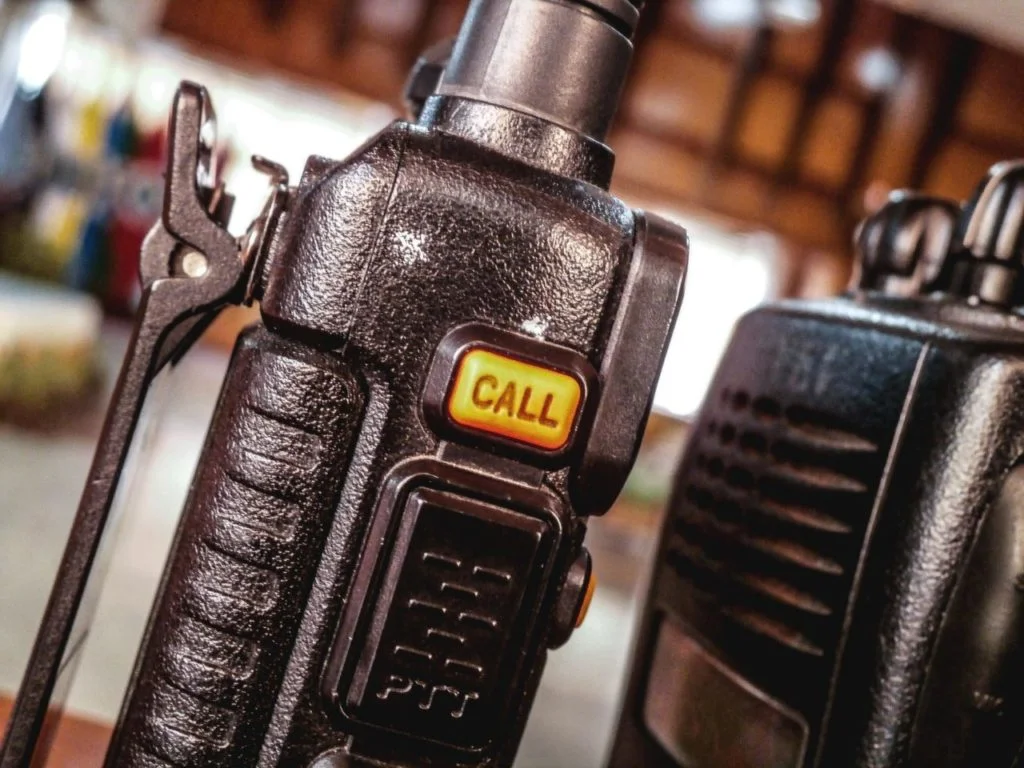
World War II is where things got serious. The military needed something a soldier could actually carry and use on the move. In 1940, a Canadian engineer named Donald Hings developed a portable field radio he called the “packset.” Around the same time, Motorola engineer Alfred Gross was working on similar technology. Motorola’s SCR-300 — the “walkie talkie” — shipped to Allied forces in 1943.
That’s 48 years from Marconi’s first 1.5-mile transmission to a soldier carrying a two-way radio on a battlefield. Four-plus decades of miniaturization, transistors, and engineering refinement.
After the war, that technology didn’t disappear — it went civilian. Construction sites, security teams, event crews. The same core principle Hertz proved in 1887 is powering the walkie talkies sitting on your job site right now.
Understanding radio frequencies today still comes back to the same electromagnetic wave behavior Hertz was studying in his lab. And the difference between UHF vs VHF — which matters a lot for practical radio use — traces directly back to the wave propagation science those early pioneers were figuring out.
Radio Today — From Invention to Modern Day
Radio didn’t get replaced by the internet. It adapted.
AM broadcasting took off in the 1920s. FM radio arrived in 1933 — Edwin Armstrong invented it, and the audio quality was dramatically better than AM. By the 1960s, FM was everywhere. Then came digital radio, satellite radio, HD radio. And two-way radio kept developing in parallel — from military walkie talkies to the digital DMR and GMRS radios professionals use today.
The Sony TR-55 in 1954 was the first transistor radio — suddenly you could carry radio in your shirt pocket. That was a bigger deal than it sounds. It put personal radio in the hands of ordinary people for the first time. Teenagers were listening to rock and roll on pocket radios by the late 1950s. The culture shifted.
Today, radio frequency technology is baked into things people don’t even think of as “radio.” WiFi runs on radio frequencies. Bluetooth is radio. Cell phones are radio. The GPS in your truck is receiving radio signals from satellites. Every single one of those technologies owes a debt to Hertz, Tesla, Marconi, and the engineers who came after them.
Good radio communication — whether you’re managing a construction site or running security at a venue — still depends on understanding the fundamentals. Frequency, range, interference, line of sight. That’s 130-year-old physics that still applies every single day.
And it all started with a 21-year-old Italian sending a signal 1.5 miles across a field in 1895.
Common Questions
When was the radio invented?
Who invented the radio — Marconi or Tesla?
When was the first radio broadcast?
When was FM radio invented?
How did radio lead to walkie talkies?
What year did commercial radio start?
Did you know Alexa can play radio too? See how to play radio stations on Alexa.
Having DAB issues? See why your DAB radio is not picking up stations and how to fix it.
Did you know London has a famous Walkie Talkie building? The skyscraper got its name from its distinctive shape.