
Last updated on August 5th, 2026 at 04:21 am
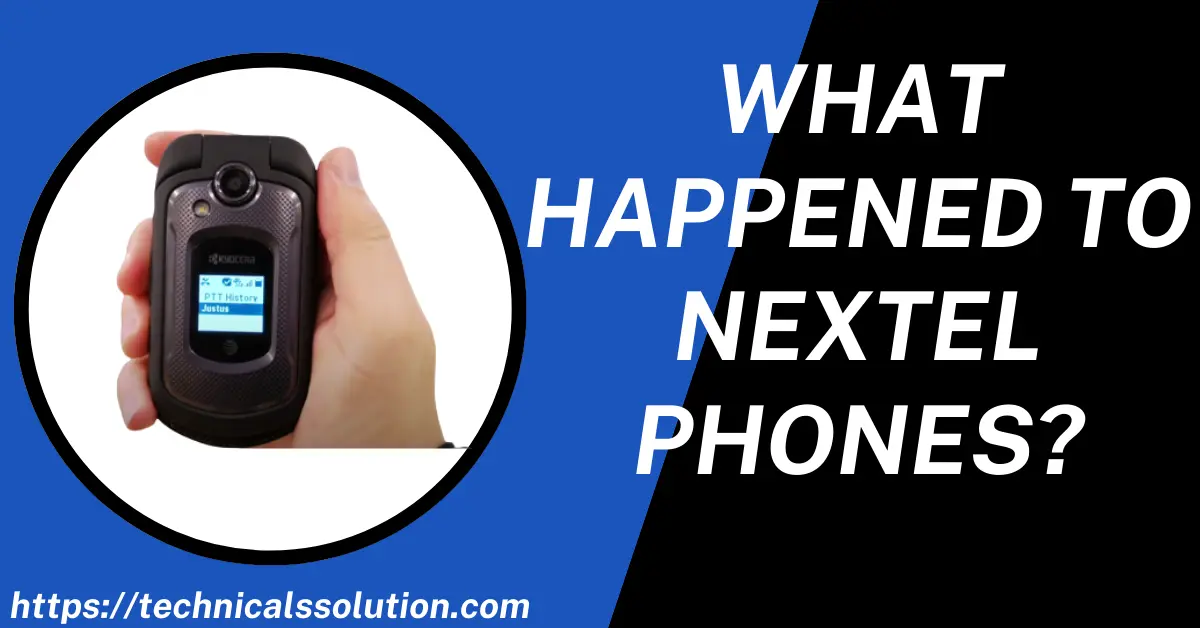
What happened to Nextel phones? Nextel shut down its iDEN network on June 30, 2013. Sprint acquired the company in 2005 for $35 billion, but the proprietary Motorola iDEN technology that powered Nextel’s push-to-talk couldn’t be upgraded to 4G LTE. Sprint pulled the plug and repurposed the 800MHz spectrum for its LTE network. The Direct Connect PTT brand lives on today under T-Mobile.
What Was Nextel?
Nextel started life in 1987 as a company called Fleet Call. Not exactly a memorable name. But the idea behind it was smart � build a nationwide network for fleet workers, dispatchers, and field crews who needed fast, reliable communication without the back-and-forth of a regular phone call.
They rebranded as Nextel in 1993. And that’s when things started moving fast.
The whole network ran on iDEN � Integrated Digital Enhanced Network � a technology developed by Motorola. It was proprietary. That means Nextel didn’t share it with anyone, and nobody else ran on it. That exclusivity became both their biggest strength and, eventually, their biggest problem.
The flagship feature was Nextel’s walkie talkie-style push-to-talk � what they called Direct Connect. You pressed a button. The other person heard you instantly. No dialing. No ringing. No waiting. If you’ve ever run a job site, managed a security team, or coordinated a delivery fleet, you already know exactly why that mattered.
Why Was Nextel So Popular?
I’ll be straight with you. The people who loved Nextel weren’t tech enthusiasts. They were contractors, truckers, warehouse managers, security supervisors, EMTs, and field reps. People who actually needed to communicate fast across long distances without screwing around with a phone interface.
Think about it this way. You’re running a 30-man construction crew across two floors of an active build site. You need to reach your foreman right now � not in 30 seconds, not after three rings. Direct Connect got you there in under a second. That’s not a feature. That’s a workflow.
By 2004, Nextel had hit 17 million subscribers. That’s peak Nextel. And those weren’t casual users � those were businesses and crews who had built their entire communication setup around Direct Connect. Replacing it wasn’t a small ask.
The phones themselves were built for punishment. Motorola made most of them. They were chunky, loud, and hard to kill. Not flashy. But if you dropped one off a ladder onto a concrete floor � and I’ve seen it happen � it usually survived. Sound familiar?
And the coverage was different too. iDEN used the 800MHz spectrum, which travels farther and penetrates buildings better than higher frequencies. If you were deep inside a warehouse or in a basement parking structure, Nextel still worked when other carriers didn’t.
The Sprint Nextel Merger (2005)
Here’s where things start going sideways.
In 2005, Sprint bought Nextel for $35 billion. At the time it looked like a smart play. Sprint got the subscribers, the spectrum, and � most importantly � the business customers that were loyal to Direct Connect. It was one of the biggest telecom mergers in US history.
But the two networks never really worked together. Sprint ran on CDMA. Nextel ran on iDEN. These weren’t just different technologies � they were fundamentally incompatible. You couldn’t take a Nextel phone and put it on Sprint’s network. You couldn’t combine infrastructure. You basically had two completely separate companies operating under one name.
The integration was a mess. Customers got confused. Service quality slipped. Business customers who’d depended on Nextel for years started getting frustrated. Sprint hemorrhaged those subscribers for years after the merger closed.
And then the industry started moving toward 4G LTE. That’s when the clock really started ticking for iDEN.
Why Did Nextel Shut Down?
iDEN couldn’t scale to 4G. That’s the short version.
The longer version is this: Motorola built iDEN in an era when push-to-talk efficiency was the whole point. It was never designed to handle the data-heavy demands of smartphones, streaming, or modern mobile apps. By the late 2000s, customers weren’t just making calls anymore � they expected everything. iDEN couldn’t deliver that.
And here’s the other problem. The 800MHz spectrum that iDEN ran on? That was valuable real estate. Sprint needed it for LTE buildout. You can’t run a legacy PTT network and a 4G LTE network on the same spectrum at the same time. Something had to give.
So Sprint made the call. The iDEN network shutdown date was set for June 30, 2013. After that date, every Nextel iDEN device stopped working. Done. Gone.
It wasn’t just about technology, either. Maintaining the iDEN infrastructure cost money � real money � and the subscriber base had been shrinking for years as people migrated to smartphones. By 2013, keeping iDEN alive wasn’t worth what it cost. The math didn’t work anymore.
That 800MHz spectrum was repurposed for Sprint’s LTE network. The frequencies that used to carry Direct Connect calls were now carrying data for regular smartphone users. That’s the unsexy reality of what happened to Nextel.
What Happened to Nextel Customers?
Sprint gave customers notice well in advance of the June 2013 shutdown. The message was simple: migrate to Sprint’s CDMA network or find another carrier.
Some customers made the jump. Sprint offered deals on new devices and tried hard to keep the business accounts that had come over with the merger. But a lot of those customers � especially the trade and field workers who’d built their operations around Direct Connect � weren’t happy with what they were getting in return.
You know what’s hard to replace? A sub-second push-to-talk connection that your entire crew knows how to use. Handing someone a smartphone and saying “there are PTT apps for that” doesn’t cut it when you’re on a deadline and your guys need to talk right now.
A lot of the old Nextel business base scattered. Some went to Verizon. Some went to AT&T. Some looked at dedicated two-way radios for short-range on-site communication and PTT smartphones for longer range. Others tried third-party PTT apps and got mixed results.
The honest truth? Nextel left a gap that took years to properly fill. And some people would argue it still hasn’t been fully filled � at least not with the same seamless, hardware-integrated experience that iDEN delivered at its peak.
What Replaced Nextel?
A few things, depending on what you needed.
For pure on-site communication � a job site, a warehouse floor, an event � traditional walkie talkies and two-way radios filled the gap. They’re cheaper to run, don’t depend on a cellular network, and honestly work better for tight-range team communication anyway. If your crew’s all within half a mile of each other, a solid set of business-band radios gets the job done. No monthly fee, no carrier dependency.
For wider-area PTT � the kind Nextel was actually built for � carriers started offering push-to-talk over cellular. Sprint launched Direct Connect on its CDMA network before the T-Mobile merger. AT&T has Enhanced Push-to-Talk. Verizon has Push to Talk Plus. The technology works. The experience is close. But it’s not identical to what iDEN delivered.
And then there are PTT apps. Zello is the most widely used. It runs on any smartphone, it’s cross-platform, and it can connect people across the country instantly over data. It’s genuinely useful for teams that are spread out. Understanding good radio communication protocol helps with these too � the discipline translates.
The landscape now is fragmented where Nextel was unified. There’s no single carrier that dominates the PTT-for-business space the way Nextel once did. That’s both a loss and an opportunity depending on how you look at it.
Can You Still Get Nextel-Style PTT?
Yes. But it’s spread across a few different options now.
T-Mobile � which absorbed Sprint � still offers a Direct Connect product for business customers. The brand name survived even if the iDEN network didn’t. It runs over T-Mobile’s 4G/5G network. The coverage is better than iDEN ever was. The latency isn’t quite the same, but it’s close enough for most work scenarios.
If you want to explore dedicated LTE push-to-talk hardware, Rapid Radios fills the gap Nextel left — cellular PTT without a carrier contract. If you want dedicated hardware that doesn’t depend on a carrier at all, explore your modern PTT options � from FRS and GMRS radios up through commercial-grade units. For crews working in a defined area, this is still often the most reliable setup.
Some of the newer PTT devices also support VOX � voice-activated transmission � so you don’t even need to press a button. Hands-free communication on a job site. That would’ve seemed impossible in the early Nextel days.
Nextel International is also still operating. In parts of Latin America, the brand and even some iDEN-based infrastructure continued well past the US shutdown. So the Nextel name isn’t completely gone from the world � just from the US market.
Look � if you used Nextel in its prime and you’re still chasing that same experience, you’re not going to find a perfect replica. But you can get close. The PTT ecosystem today is more varied and more capable than it was in 2013. You just have to know what you’re looking for.