
Last updated on July 25th, 2026 at 03:30 pm
post_content
I’ve run crews in construction and security for 15 years. I’ve gone through cheap blister packs from the hardware store, mid-range stuff from big box retailers, and full commercial-grade units that cost more than my first truck payment. And here’s what I’ve learned — the difference between a radio that’s actually rated military grade and one that just looks tough is the difference between a tool and a toy. You don’t find out which one you’ve got until things get ugly.
This isn’t a list I put together from spec sheets. I’ve handled all of these units. Dropped them. Soaked them. Run them through cold mornings and hot afternoons on site. What follows is an honest breakdown of what works, what’s overhyped, and where your money actually makes sense — depending on what you’re trying to do.
Quick Comparison
What Makes Military Grade Two Way Radios Different From Consumer Radios?
Let’s cut through the marketing garbage first. “Military grade” gets slapped on everything from phone cases to water bottles. In the radio world, it actually means something specific — and if a product can’t point to a real certification, you should be skeptical.
The standard you’re looking for is MIL-STD-810. That’s a US military testing protocol covering temperature extremes, humidity, vibration, shock, altitude, and rain. The current version is MIL-STD-810H. The previous version — 810G — is still solid, but 810H added tougher testing for transit drops and more realistic field conditions. If a radio passes either, it’s been through something. If it hasn’t been tested to either standard, it’s just plastic with a tough-looking shell.
Then there’s the IP rating — Ingress Protection. This is a two-digit number. The first digit covers dust. The second covers water. Here’s what the numbers mean in plain English:
| IP Rating | What It Actually Means |
|---|---|
| IP54 | Dust protected, splash resistant — not waterproof. Don’t drop it in a puddle. |
| IP55 | Dust protected, low-pressure water jets from any direction. Still not submersible. |
| IP67 | Fully dust tight, survives submersion up to 1 meter for 30 minutes. |
| IP68 | Fully dust tight, survives submersion beyond 1 meter — depth specified by manufacturer. |
The jump from IP54 to IP67 is massive. One is a radio you keep dry. The other is a radio you don’t worry about. Know which one you’re buying before you trust it on a job site in the rain.
Motorola Solutions R7
Best for: Public safety, construction managers
/5

| Spec | Detail |
|---|---|
| MIL-STD | MIL-STD-810H |
| IP Rating | IP68 |
| Battery Life | 15 hours |
| Range | 3–5 miles |
| Frequency | UHF and VHF versions available |
| Encryption | AES-256 |
| Price | $400–$600 |
Look — I get it. $400 to $600 for a walkie talkie sounds insane. But if you’re running a 20-person crew across a noisy warehouse floor or managing a multi-story commercial build, the R7 is in a different league from everything else on this list. IP68 means it’s survived being submerged beyond a meter — not just splashed. MIL-STD-810H means it’s passed the most current military testing standard available. That’s not marketing. That’s documented.
15 hours of battery. I ran this thing from 7am to 10pm on a long security detail and it still had charge left. Nothing worse than a dead radio at 6pm when your crew is still on site and the shift isn’t done. AES-256 encryption means your communications stay private — and if you’re in public safety or handling anything sensitive, that’s not optional, that’s mandatory. The R7 also gives you the choice between UHF and VHF versions, which matters depending on your terrain and what existing infrastructure you’re working with.
Here’s the honest part. It’s heavy. Heavier than the Icom, heavier than the Kenwood. After a 12-hour shift with this clipped to your vest, you feel it. And you’ll need an FCC Part 90 license to operate it legally — so if you were hoping to just rip it out of the box and start using it, that’s not how this works. But for anyone serious about field communications, neither of those is a dealbreaker. They’re just facts to plan around.
Pros
- Highest MIL-STD-810H certification available
- IP68 — survives full submersion, not just rain
- 15-hour battery covers even double shifts
- AES-256 encryption for sensitive communications
- UHF and VHF versions — flexibility built in
Cons
- Premium price — not for casual or occasional use
- Requires FCC Part 90 license to operate legally
- Heavier than most — you’ll notice it by end of shift
Verdict
Bottom line: if budget isn’t the issue and you need something that genuinely won’t let you down in serious field conditions — this is it.
Best for: Security teams, field operations
Icom IC-F4400DS
/5
| Spec | Detail |
|---|---|
| MIL-STD | MIL-STD-810G and 810H |
| IP Rating | IP67 |
| Battery Life | 12 hours |
| Range | 3–4 miles |
| Frequency | UHF only |
| Encryption | AES-256 |
| Price | $300–$500 |
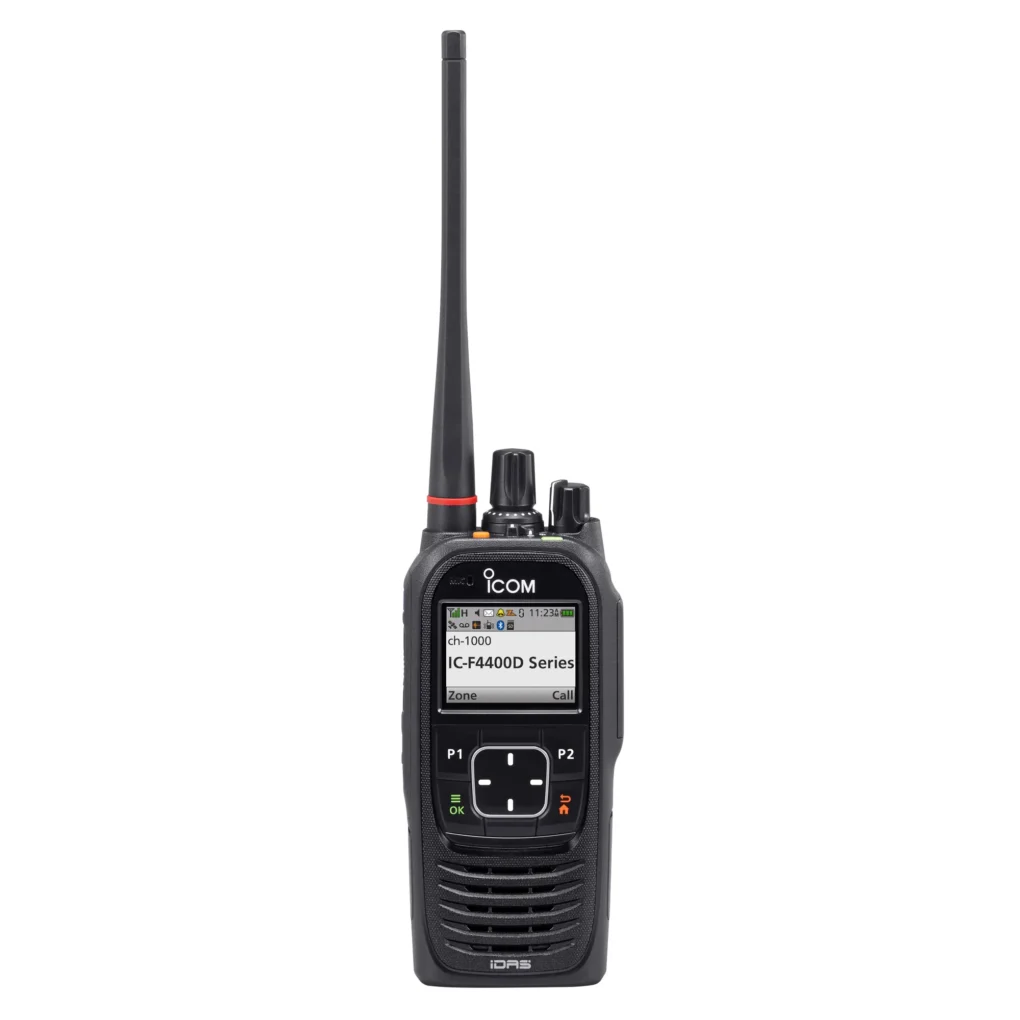
The Icom IC-F4400DS is the radio I’d hand to a security team supervisor running a 10-man rotation across a campus or event venue. It’s lighter than the Motorola R7 — you notice the difference immediately when you pick them both up — and it carries dual MIL-STD-810G and 810H certification, which is genuinely impressive. IP67 means it’ll survive a drop into standing water up to a meter deep. And it’s got AES-256 encryption built in, so your comms stay where they’re supposed to stay.
Here’s what makes the F4400DS stand out in mixed environments: it runs both digital and analog. If your operation already has older analog radios in the fleet, this unit bridges that gap without forcing you to replace everything at once. That’s a real-world money saver. I’ve seen security operations try to go all-digital overnight and end up with half their crew unable to communicate because somebody’s six-year-old Motorola didn’t get the memo.
But the 12-hour battery is genuinely a weak point. That’s a standard single shift covered — but if you’re running doubles or 24-hour operations, you’ll need backup batteries on hand. And the programming? Don’t expect to do it from the front panel. You’ll need Icom’s dedicated software and someone who knows how to use it. That’s not a dealbreaker, but it’s not plug-and-play either.
Pros
- Certified to both MIL-STD-810G and 810H
- Digital and analog compatibility — works with older gear
- Lighter and more compact than the Motorola R7
- AES-256 encryption included as standard
Cons
- UHF only — no VHF option if your operation needs it
- 12-hour battery falls short for double shifts
- Programming requires dedicated software — not beginner-friendly
Verdict
Bottom line: if you’re running security or field ops and need something lighter than the R7 that still plays serious — the Icom IC-F4400DS earns its place on the belt.
Best for: Mining, utilities, enterprise operations
Hytera HP782
/5
| Spec | Detail |
|---|---|
| MIL-STD | MIL-STD-810G (not updated to 810H) |
| IP Rating | IP67 |
| Battery Life | 16 hours |
| Range | 3–5 miles |
| Frequency | DMR Digital Standard |
| Encryption | AES-256 |
| Price | $350–$550 |
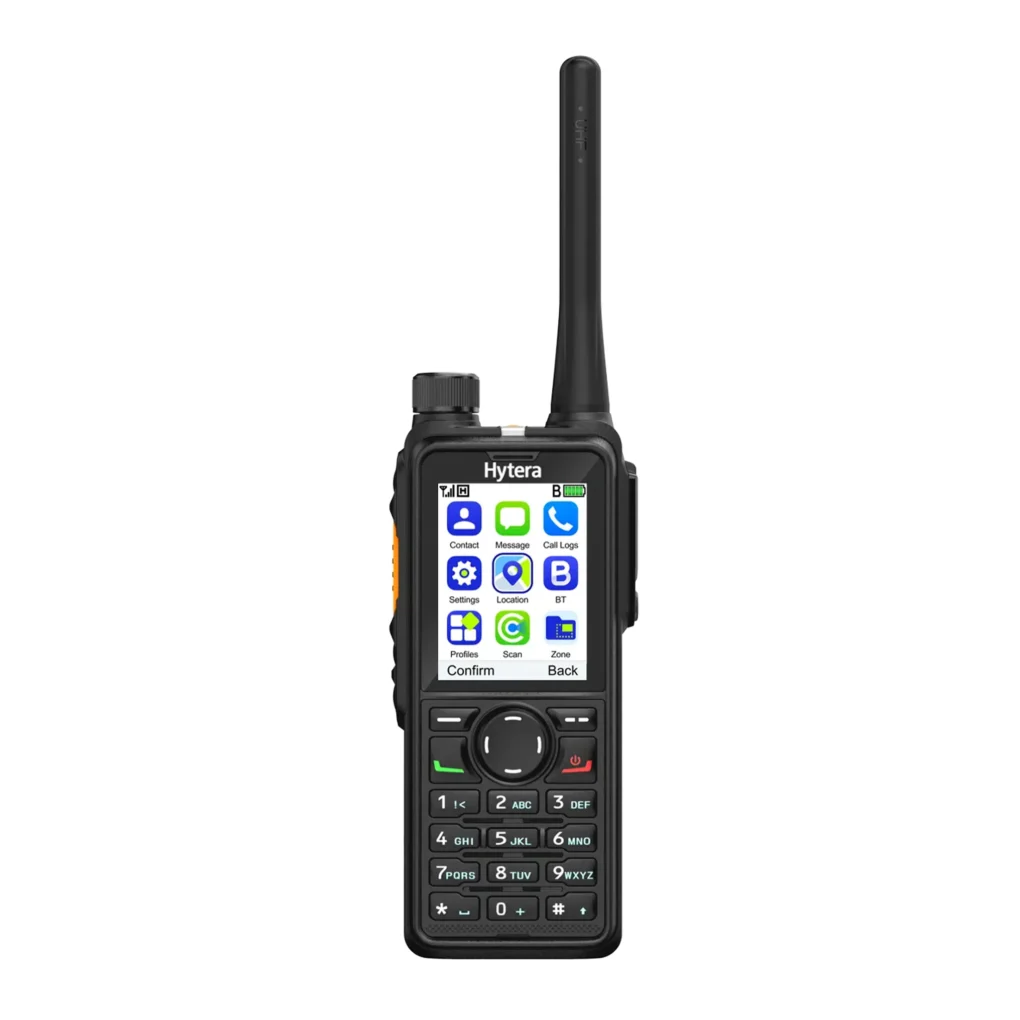
16 hours. That’s the number that grabs your attention with the Hytera HP782, and it should. That’s the longest battery life on this entire list — longer than the Motorola, longer than the Icom. If your operation runs extended shifts, 24-hour sites, or you just hate charging equipment in the middle of the day, the HP782 deserves a serious look. IP67 means it handles full submersion up to a meter, and it runs DMR digital standard with AES-256 encryption built in.
The Bluetooth audio support is actually useful in the field. If you’re in a mining or utilities environment where you’re using ear protection and don’t want a cable dangling from your radio, wireless audio matters. That’s a feature the Motorola R7 doesn’t offer at this level. And the range — 3 to 5 miles — matches the R7. So this isn’t a unit that’s compromising on performance to get that battery life.
But here’s where I have to be straight with you. The HP782 runs MIL-STD-810G, not the updated 810H. That’s a real difference if you’re in extreme environments. And Hytera’s US service network is thinner than Motorola’s or Icom’s — if this thing needs repair, finding a local authorized shop isn’t always easy depending on where you’re operating. The learning curve is also steep. This isn’t something you hand a new crew member and expect them to figure out in 20 minutes.
Pros
- 16-hour battery — longest on this list
- IP67 fully weatherproof — handles submersion
- Bluetooth audio support for wireless ear protection
- DMR digital standard with AES-256 encryption
Cons
- MIL-STD-810G only — not updated to current 810H
- Thin US service network — authorized shops hard to find
- Steep learning curve — not for untrained users
Verdict
Bottom line: if you’re running long-haul operations — mining, utilities, extended field work — and battery life is the deciding factor, the Hytera HP782 delivers where it counts. Just know the service network isn’t what Motorola’s is.
Best for: Construction sites, events, no license required
Kenwood NX-P1302AUK
/5

| Spec | Detail |
|---|---|
| MIL-STD | MIL-STD-810G |
| IP Rating | IP54/55 — splash resistant ONLY |
| Battery Life | 18 hours |
| Range | 2–3 miles |
| Frequency | PMR446 license-free |
| Encryption | None |
| Price | $100–$200 |
The Kenwood’s IP54/55 rating drives me crazy — and I need to say that upfront. The marketing makes this sound like a tough field radio. And in some ways it is — MIL-STD-810G is real, and the 18-hour battery is genuinely the best figure in this entire test. But IP54/55 means splash resistant. Light rain, not downpour. A quick wipe down, not a drop in standing water. If your job involves any real exposure to water — river crossings, jobsite flooding, heavy rain on an open site — don’t buy this and assume you’re covered. You’re not.
That said, for the right use case, this Kenwood makes a lot of sense. License-free PMR446 operation means you can hand these to your crew tomorrow without filing anything with the FCC. 18 hours of battery is staggering for the price point. And the setup is genuine plug-and-play — turn it on, pick a channel, talk. If you’re running a small construction crew, coordinating staff at an outdoor event, or managing a short-range operation where sensitive communications aren’t a concern, this delivers honest value at $100 to $200.
But zero encryption. None. Whatever you say on this radio, anyone with a scanner nearby can hear it. Don’t use this for anything sensitive. Don’t coordinate security positions on it. Don’t discuss anything you wouldn’t say on a loudspeaker. For basic crew coordination on a noisy site? Fine. For anything that requires privacy? Look elsewhere.
Pros
- License-free PMR446 — use it right out of the box
- 18-hour battery — best in this entire test
- Most affordable certified option on the list
- Simple plug-and-play — no software, no programming
Cons
- IP54/55 only — splash resistant, NOT waterproof
- Zero encryption — completely open communications
- Shorter range than commercial-grade options
Verdict
Bottom line: if you need something certified, affordable, and license-free for a construction crew or outdoor event team, the Kenwood NX-P1302AUK is the honest value choice. Just don’t call it waterproof.
Best for: Outdoor recreation, camping, casual use
Retevis RT29 Pro
/5
| Spec | Detail |
|---|---|
| MIL-STD | None — not certified |
| IP Rating | IP67 |
| Battery Life | 12 hours |
| Range | 1–3 miles real-world |
| Frequency | FRS channels — no license needed |
| Encryption | None |
| Price | $40–$80 per pair |
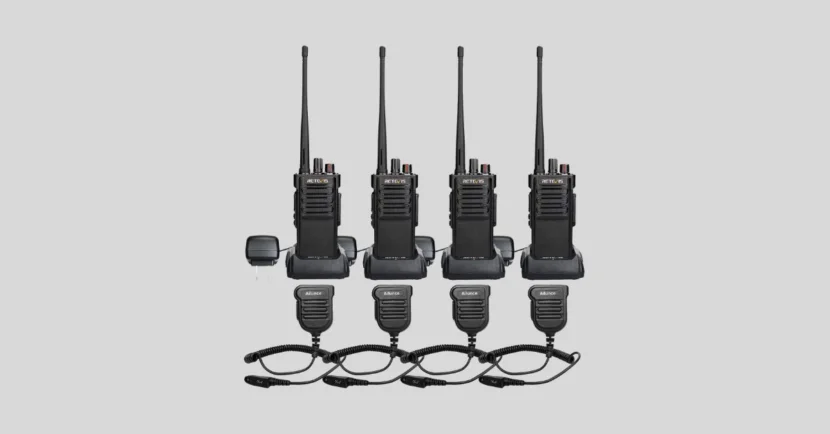
Honestly? The Retevis surprised me. At $40 to $80 for a pair, I expected garbage. What I got was a genuinely waterproof radio — IP67 is real, it handles submersion — that’s easy to set up and works fine for what it is. But here’s the thing nobody tells you when they’re trying to sell you these: the Retevis RT29 Pro is not a military grade radio. It has zero MIL-STD-810 certification. None. The casing looks tough. The IP67 rating is legitimate. But it hasn’t been tested to any military standard, and the build quality tells you that pretty quickly when you handle it side by side with the Motorola or the Icom.
The range claims on the box? Ignore them. In open flat terrain with nothing in the way, you might squeeze 3 miles. In a real environment — trees, buildings, hills, anything — expect 1 to 2 miles on a good day. And the 12-hour battery is decent for the price, but the Kenwood above it beats it at 18 hours for not that much more money.
Where does this make sense? Camping trips. Hiking with a group. A family event where you need to stay in contact across a park or fairground. Maybe as a backup radio when your primary gear is charging. But if you’re running a job site, a security operation, or anything where communication failure actually has consequences — don’t lean on these. They’re fine tools for what they are. They’re just not what the military grade label implies.
Pros
- IP67 waterproof — legitimate rating at an unbeatable price
- No license required on FRS channels
- Solid 12-hour battery life for the price point
- Out of the box ready — no setup required
Cons
- NOT MIL-STD-810 certified — not military grade, full stop
- Zero encryption — completely open communications
- Consumer-level build quality underneath the IP67 shell
- Real-world range is significantly below box claims
Verdict
Bottom line: the Retevis RT29 Pro is a solid budget waterproof radio for casual outdoor use. But call it what it is — it’s not military grade, and you shouldn’t trust it in situations where communication actually matters.
Which Military Grade Two Way Radios Are Best for Your Situation?
Here’s the thing nobody walks you through when you’re standing in front of a product page trying to decide. The right radio depends entirely on what you’re actually doing — and the wrong choice costs you money in either direction. Buy too cheap and you replace it in six months. Buy more than you need and you’ve paid for features you’ll never touch.
Tier 1 — No license, basic crew communication: If you’re running a small crew at an outdoor site, coordinating event staff, or just need something that works out of the box without dealing with the FCC — look at the Kenwood NX-P1302AUK. It’s license-free, affordable, and the 18-hour battery is genuinely impressive. Or if you’re shopping for recreational use, the Retevis RT29 Pro is fine. Just know you’re not buying a military grade radio with the Retevis — you’re buying a decent budget option with a good IP rating.
Tier 2 — Licensed commercial use, mixed environments: You need a license — specifically an FCC Part 90 license — to operate the Icom IC-F4400DS, Hytera HP782, or Motorola R7 legally. Don’t skip this step. For a breakdown of what requires licensing and what doesn’t, see the FRS and GMRS frequency guide. For security teams and field operations running standard shifts, the Icom is hard to argue with. For extended operations where battery life is the deciding factor, the Hytera’s 16-hour runtime earns serious consideration.
Tier 3 — Public safety, construction management, critical communications: Spend the money on the Motorola R7. It’s not cheap. But IP68 submersion protection, MIL-STD-810H, AES-256 encryption, and 15 hours of battery in a single unit is a combination nothing else on this list fully matches. If the budget is there and the stakes are real, this is the answer. For a full breakdown of how range holds up in different environments, see the walkie talkie range guide.
UHF vs VHF in plain English: UHF penetrates buildings better — the right choice for urban environments, construction sites, warehouses, multi-story buildings. VHF travels farther in open terrain — think outdoor events, rural land, forestry. Most radios here are UHF. The Motorola R7 gives you a choice between both versions. For more on how terrain affects your signal, see the UHF vs VHF comparison. For civilian-rated rugged options at lower price points, see the heavy duty walkie talkies guide.
Military-grade handhelds are one end of the handheld walkie talkie spectrum — for a full breakdown of FRS, GMRS, MURS, and business band options across every use case and budget, see the handheld walkie talkie guide.
Military-grade handhelds are one end of the handheld walkie talkie spectrum — for a full breakdown of FRS, GMRS, MURS, and business band options across every use case and budget, see the handheld walkie talkie guide.
For law enforcement-grade radio specifications — P25 digital standard, AES-256 encryption, trunked network infrastructure — the what radios do police use page covers the full breakdown of Motorola APX and L3Harris models officers actually carry.
Frequently Asked Questions
What does military grade walkie talkie actually mean?
It means the radio has been tested to MIL-STD-810 — a US military protocol covering temperature extremes, humidity, vibration, drop shock, altitude, and more. The current version is MIL-STD-810H. Without that certification, “military grade” is just a marketing phrase. Always check the actual spec sheet before you trust that claim.
Do military grade walkie talkies need a license?
Most do. Commercial radios like the Motorola R7, Icom IC-F4400DS, and Hytera HP782 require an FCC Part 90 license to operate legally in the US. The Kenwood NX-P1302AUK runs on license-free PMR446. The Retevis RT29 Pro runs on FRS — also license-free. Operating a licensed radio without one isn’t worth the risk. Get the license.
What is the range of a military grade walkie talkie?
Typically 3 to 5 miles in open terrain for commercial-grade units. Real-world range drops significantly in urban environments, inside buildings, or anywhere with obstacles. The Motorola R7 and Hytera HP782 both reach 3 to 5 miles. The Kenwood and Retevis are realistically 1 to 3 miles. Range claims on boxes are always best-case — don’t buy based on that number alone.
Are military grade walkie talkies waterproof?
The good ones are. IP67 and IP68 rated radios handle full submersion. The Motorola R7 is IP68 — the highest rating here. The Icom, Hytera, and Retevis are all IP67 — genuinely waterproof up to 1 meter. The Kenwood NX-P1302AUK is only IP54/55 — that’s splash resistant, not waterproof. There’s a real difference. Know what rating you’re buying before you trust it in the rain.
What’s the difference between MIL-STD-810G and MIL-STD-810H?
810H is the newer, tougher standard, updated in 2019 with more rigorous testing for transit drops, vibration, and conditions that better reflect real field use. A radio certified to 810G has still been through serious testing — but 810H is the current benchmark. If you’re buying for extreme environments, 810H certification matters.
Can I use a military grade radio without a license?
Depends on the radio. License-free options like the Kenwood NX-P1302AUK (PMR446) and Retevis RT29 Pro (FRS) need no license. Commercial radios like the Motorola R7, Icom IC-F4400DS, and Hytera HP782 require an FCC Part 90 license. Operating without one is illegal. The licensing process isn’t complicated, but it’s not optional.
What makes a walkie talkie military grade?
MIL-STD-810 certification covering shock, vibration, temperature extremes, dust, and water resistance. Combined with an IP67 or IP68 rating. True military-grade two-way radios also use encryption (AES-256 or P25), operate on VHF/UHF commercial frequencies, and are built to function in conditions that would destroy consumer hardware. A tough-looking shell with no certification is not military grade.
How much do military grade walkie talkies cost?
Properly certified military grade two-way radios start around $300 and go up to $600+ per unit for commercial-grade options like the Motorola R7 and Icom IC-F4400DS. Budget options marketed as military grade — like the Retevis RT29 Pro at $40–80 — don’t carry actual MIL-STD-810 certification. The Kenwood NX-P1302AUK hits a middle ground at $100–200 with real MIL-STD-810G certification and license-free operation.