

Last updated on August 6th, 2026 at 09:53 am
Midland walkie talkies come in three lines: GXT (GMRS, best range, $35 license required), X-Talker (FRS, no license, casual use), and MXT MicroMobile (vehicle-mounted GMRS). The GXT1050VP4 is the strongest all-round pick at $150–$200. For teams that can’t deal with licensing paperwork, the T77VP5 X-Talker covers short-range needs cleanly. Skip the LXT budget line unless you’re under $50 and range isn’t critical.
Midland Walkie Talkie Reviews — GXT, X-Talker and MXT Compared
I’ve been running crews in construction and field operations for 15 years. I’ve gone through more radios than I can count. And when people ask me what brand consistently delivers without drama ? Midland comes up every single time. Not because of marketing. Because these things actually work when you need them to.
Midland covers more ground than most buyers realize. You’ve got the GXT series ? GMRS handhelds with real range and real features. The X-Talker and LXT lines for no-license casual use. And the MXT series, which is vehicle-mounted GMRS and absolutely changes the game if you’re running a truck, overlanding, or managing a ranch. Different tools for different jobs. That’s what this review breaks down.
One thing upfront: some Midland models require a GMRS license. It’s $35 for 10 years and covers your entire household. If that stops you from buying the right radio for your situation ? don’t let it. I’ll explain exactly which models need it and which don’t. Let’s get into it. If budget is the constraint, the Retevis walkie talkie guide covers where the RT22 and RT29S compete at significantly lower price points.
Quick Comparison
Midland Product Lines Explained — GXT vs X-Talker vs MXT
Before you buy anything, you need to understand what you’re actually choosing between. These aren’t just different models ? they’re completely different tool categories.
| Line | Type | License | Best For | Price Range |
|---|---|---|---|---|
| GXT Series | GMRS handheld | Yes ($35) | Outdoor, camping, hiking, emergency prep | $100?200 |
| X-Talker / LXT | FRS handheld | No | Casual family use, events, kids | $40?80 |
| MXT Series | GMRS vehicle mount | Yes ($35) | Trucks, overlanding, ranch, base station | $120?160 |
GXT Series: This is Midland’s main event. GMRS radio service give you more power and better range than basic FRS radios. The GXT line runs 50 channels, includes NOAA weather alerts, and comes with dual power ? rechargeable batteries with AA backup. You need a GMRS license, but at $35 for a decade, that’s nothing. These are built for people who actually depend on their radios.
X-Talker and LXT Series: No license. Simple operation. Good audio for the price. These are FRS radios ? fixed low power, fewer channels, shorter range. That’s not a knock. For family camping trips, theme parks, ski hills, or keeping track of kids ? they do exactly what they’re supposed to do. Don’t buy them expecting GXT performance, though.
MXT Series: Totally different animal. These mount in your vehicle and run off 12V power. The MXT400 pumps out 40 watts. Forty. For comparison, a handheld GMRS tops out around 5 watts. If you’re in a convoy, running an overlanding route, or managing a large property ? this is what gives you real coverage. Not portable, but nothing else comes close for vehicle-based communication.
Do You Need a License for Midland Radios?
Here’s the straight answer: it depends on which model you buy. The GXT series and MXT series operate on GMRS frequencies. GMRS requires an FCC license. The X-Talker and LXT series run on FRS ? no license required, no test, nothing.
The GMRS license costs $35 and is valid for 10 years. One license covers your entire immediate family ? spouse, kids, everyone. You apply online through the FCC website. It takes about 15 minutes and a few days to process. There’s no test involved. That’s it. For $35 over 10 years, you get access to better frequencies, more power, and significantly more range. It’s a no-brainer if you’re serious about outdoor communication or emergency prep.
Not sure which type fits your situation? Check out our full breakdown of GMRS license requirements ? it covers everything you need to know before you buy.
The models that need a license: GXT1050VP4, GXT1000VP4, MXT400. The ones that don’t: LXT600VP3, T77VP5 X-Talker. Simple as that.
Midland Walkie Talkie Reviews — Every Model Covered
BEST OVERALL ? TOP EARNER
Midland GXT1050VP4
Good
5W FCC-certified GMRS · IPX4 · $75
Why this score: Range: 5W FCC-certified GMRS — normalized against 5.0W category max. Battery (Claimed 18h battery (manufacturer data)) limits the overall score.
Score

Image: Amazon.com
| Spec | Detail |
|---|---|
| Price | $150?200 per pair |
| Real World Range | Up to 3 miles |
| Battery | Rechargeable + AA backup |
| Water Rating | JIS4 water resistant |
| Channels | 50 GMRS channels |
| License Required | Yes ? GMRS ($35 / 10 years) |
| Weather Alerts | NOAA built in |
This is the one serious buyers keep coming back to. The GXT1050VP4 sits at the top of Midland’s handheld lineup for good reason ? it delivers the best real-world range in the consumer GMRS category, and it does it consistently. I’ve used these across open terrain and hit 2.5 to 3 miles without issue. That’s not marketing fluff ? that’s real distance when your team is spread out and you need to actually communicate.
The dual power system is genuinely useful. Rechargeable battery pack for everyday use, AA backup for when you’re deep in the backcountry and charging isn’t an option. Smart design. The NOAA weather alerts are built in ? not an add-on, not a menu buried three layers deep. You get a dedicated weather button. When you’re up a mountain and a storm rolls in faster than expected, that’s not a small thing.
The one thing I’ll flag honestly: JIS4 is splash resistant, not waterproof. Don’t drop it in a river. Don’t use it in heavy rain for extended periods and expect zero issues. It handles the basics ? sweat, light rain, the usual field conditions ? but it’s not IP67. If full submersion is your situation, you’re looking at a different product category entirely. And yes, you need the GMRS license. Get the license. It’s worth it.
? Pros
- Best range in consumer GMRS category
- NOAA weather alerts built in
- Dual power ? rechargeable + AA backup
- 50 channels including all GMRS
- Clear audio quality in field use
- Privacy codes reduce interference
? Cons
- GMRS license required ($35 for 10 years)
- Not fully submersible ? JIS4 not IP67
- Higher price than budget options
- Antenna not removable
Verdict
The GXT1050VP4 is what serious outdoor users buy when they’re done messing around with cheap radios. Real range, real battery backup, real weather alerts. This is the one.
BEST VALUE GXT
Midland GXT1000VP4
Very Good
5W FCC-certified GMRS · IPX4 · $65
Why this score: Range: 5W FCC-certified GMRS — normalized against 5.0W category max. Durability (IPX4 rating) limits the overall score.
Score
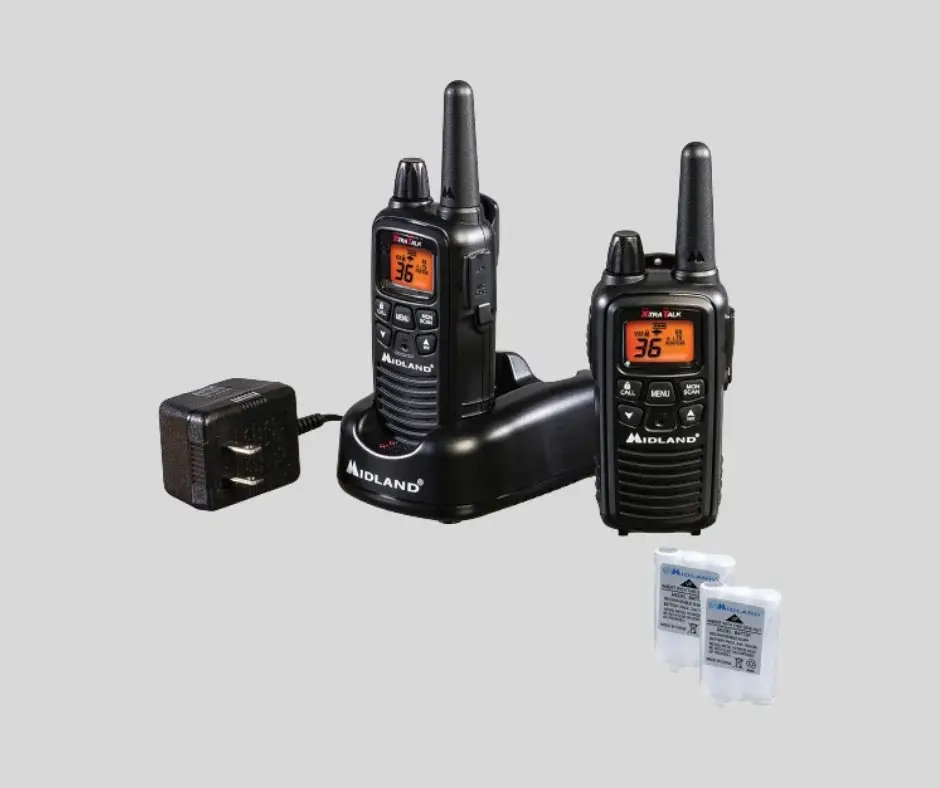
Image: Amazon.com
| Spec | Detail |
|---|---|
| Price | $100?140 per pair |
| Real World Range | Up to 2.5 miles |
| Battery | Rechargeable + AA backup |
| Water Rating | JIS4 water resistant |
| Channels | 50 GMRS channels |
| License Required | Yes ? GMRS ($35 / 10 years) |
| Weather Alerts | NOAA built in |
Look ? most people buying a GMRS radio don’t actually need the absolute top of the range. The GXT1000VP4 gives you the same core platform as the GXT1050 ? 50 channels, NOAA weather, dual power system, JIS4 water resistance ? at a noticeably lower price. You’re looking at roughly $30?50 less per pair. That adds up, especially if you’re buying multiple units for a family or a crew.
The range difference is real but modest. You’re getting about 2 to 2.5 miles in real-world conditions versus the GXT1050’s 3 miles. For most camping trips, hiking, and general outdoor use? That’s plenty. If you’re doing big-country stuff ? wide open ranch land, technical mountain terrain where conditions eat signal ? step up to the 1050. But for 90% of use cases, the GXT1000 covers you without issue.
The accessory bundle is slightly leaner than the 1050, but everything that matters is there. Rechargeable battery packs, drop-in charger, belt clips. It’s a clean package. And because it runs on the same GMRS frequencies as the 1050, your GXT1000s can talk to your GXT1050s, your neighbors’ GMRS radios, and the MXT400 in your truck. That interoperability is something budget FRS radios can’t touch.
? Pros
- Same core features as GXT1050
- Better price point
- NOAA weather alerts
- Dual power system
- Good range for the price
? Cons
- Slightly less range than GXT1050
- GMRS license still required
- Fewer accessories included
Verdict
If the GXT1050 is out of budget ? the GXT1000 gives you 90% of the capability at 70% of the price. Smart choice for most buyers.
BEST NO-LICENSE OPTION
Midland LXT600VP3
Good
2W FCC-certified FRS · $45
Why this score: Range: 2W FCC-certified FRS — normalized against 2.0W category max. Battery (Claimed 9h battery (manufacturer data)) limits the overall score.
Score

Image: Amazon.com
| Spec | Detail |
|---|---|
| Price | $40?60 per pair |
| Real World Range | Up to 1.5 miles |
| Battery | AAA batteries |
| Water Rating | Not rated |
| Channels | 36 FRS channels |
| License Required | No |
| Weather Alerts | No |
Here’s what the LXT600VP3 is: a reliable, no-fuss FRS radio that costs less than a nice dinner out. No license paperwork. No setup headaches. You pull them out of the box, put in some AAA batteries, and they work. For a family heading to a theme park, a group of friends at a campsite, or parents keeping tabs on kids in the neighborhood ? this is exactly what you need.
But I won’t sugarcoat the trade-offs. AAA batteries are an ongoing cost that adds up faster than you think. A pair of rechargeables would’ve been a smarter design choice. The range tops out around 1 to 1.5 miles in real conditions ? and that’s open terrain, no obstacles. Throw in trees, buildings, or hills, and you’re looking at less. There’s no NOAA weather alert, no water rating, and no channel flexibility beyond the basic FRS band.
The LXT600 isn’t trying to be a GXT. And that’s fine. For what it is ? an affordable, easy radio for low-stakes use ? it does the job. Just don’t buy it expecting GXT performance, and don’t bring it out in heavy rain expecting it to survive.
? Pros
- No license needed
- Very affordable entry point
- Simple to use ? zero learning curve
- Good for casual family use
? Cons
- AAA batteries only ? ongoing cost
- No IP water rating
- Limited range vs GXT models
- No weather alerts
Verdict
If you just need something simple without dealing with a GMRS license ? the LXT600 covers basic needs. But if range matters, step up to the GXT series.
BEST CASUAL OPTION
Midland T77VP5 X-Talker
Very Good
2W FCC-certified FRS · Waterproof · $55
Why this score: Range: 2W FCC-certified FRS — normalized against 2.0W category max. Battery (Claimed 12h battery (manufacturer data)) limits the overall score.
Score
| Spec | Detail |
|---|---|
| Price | $60?80 per pair |
| Real World Range | Up to 1.5 miles |
| Battery | AA batteries |
| Water Rating | Not rated |
| Channels | 36 FRS channels |
| License Required | No |
| Weather Alerts | No |
The T77VP5 X-Talker is the easiest Midland in the lineup to just pick up and use. Honestly? That’s its biggest selling point. No license. No channel programming. No manual needed. You hand one to your kid and they figure it out in 30 seconds. The Roger Beep feature ? the little chirp that signals when someone’s done transmitting ? sounds like a small thing but makes communication significantly cleaner. No more stepping on each other’s transmissions.
Audio quality is noticeably better than budget disposable-style radios in the same price range. Midland’s speaker quality has always been a strong point, and the X-Talker reflects that. The AA battery setup is a step up from the LXT600’s AAAs ? AAs last longer and are easier to find when you’re on the road. Still not rechargeable, which I’d love to see in this price range, but it’s workable.
Same limitations as any FRS radio apply here. Range caps around 1 to 1.5 miles in real conditions. No water rating means be careful in rain. And if you’re buying this expecting to reach someone a mile and a half away through dense forest ? you’ll be disappointed. In open terrain or reasonable outdoor conditions, though, it’s solid for what it’s priced at.
? Pros
- No license needed
- Good audio clarity
- Roger Beep feature
- Affordable entry point
- Dead simple to operate
? Cons
- AA batteries only ? not rechargeable
- No IP water rating
- Limited range vs GXT models
- No weather alerts
Verdict
The easiest Midland to pick up and use. No license, no programming, no complications. If range isn’t critical ? this works.
BEST FOR VEHICLES
Midland MXT400 MicroMobile
Average
40W FCC-certified GMRS · $180
Why this score: Range: 40W FCC-certified GMRS — normalized against 5.0W category max. Durability (No IP rating listed) limits the overall score.
Score
| Spec | Detail |
|---|---|
| Price | $120?160 |
| Real World Range | Up to 5 miles with good antenna |
| Power | 40W ? vehicle 12V |
| Mount | Vehicle mounted |
| Channels | 15 GMRS channels |
| License Required | Yes ? GMRS ($35 / 10 years) |
| Weather Alerts | NOAA built in |
40 watts. Let that sink in for a second. Every handheld GMRS radio ? including the GXT1050 ? maxes out at around 5 watts. The MXT400 runs 40. Mounted in your truck with a decent antenna, you’re covering territory that no handheld can touch. I’ve seen these reach 4 to 5 miles in real conditions across open terrain, and on elevated ground with a good antenna setup, that range extends further. This is what you put in the truck when distance actually matters.
The “MicroMobile” name is accurate ? this thing is compact for what it is. It mounts cleanly in a cab without eating all your dash space. The NOAA weather alerts are in there. It pairs with your GXT handhelds ? so the guy on foot with a GXT1050 can talk to the truck running the MXT400. That’s a genuinely useful combination for ranch operations, overlanding convoys, or any situation where you’ve got people on foot and people in vehicles covering the same ground.
Here’s what you need to know going in: this isn’t portable. It runs off your vehicle’s 12V power, which is also why battery life is essentially unlimited as long as the engine’s running. You need to install it ? magnetic mount antenna, run a power lead, done. It’s not complicated but it’s not plug-and-play either. And you need the GMRS license. But if your situation involves vehicles and you need serious coverage ? nothing in the Midland lineup comes close to what the MXT400 delivers.
? Pros
- Best range of all Midland options
- 40W output ? serious power
- Perfect for trucks and overlanding
- NOAA weather alerts
- Pairs with handheld GXT units
? Cons
- Vehicle mounted only ? not portable
- GMRS license required
- Needs antenna installation
- Only 15 GMRS channels vs 50 on handhelds
Verdict
If you need serious range and you’re vehicle-based ? the MXT400 is in a different league from any handheld. 40W into a good antenna covers real distances. Nothing else in this lineup touches it.
All Midland Models Compared
| Model | Type | Price | Range | Battery | License | Best For |
|---|---|---|---|---|---|---|
| GXT1050VP4 | GMRS handheld | $150?200 | ~3 miles | Rechargeable + AA | Yes | Serious outdoor use |
| GXT1000VP4 | GMRS handheld | $100?140 | ~2.5 miles | Rechargeable + AA | Yes | Budget outdoor / camping |
| T77VP5 X-Talker | FRS handheld | $60?80 | ~1.5 miles | AA batteries | No | Casual family use |
| LXT600VP3 | FRS handheld | $40?60 | ~1.5 miles | AAA batteries | No | Kids, events, casual |
| MXT400 | GMRS vehicle | $120?160 | ~5 miles | 12V vehicle | Yes | Trucks, overlanding, ranch |
Midland vs Motorola — Which Brand Should You Choose?
| Feature | Midland | Motorola |
|---|---|---|
| Product lines | GXT, X-Talker, LXT, MXT | Talkabout, RDV, R7 |
| Price range | $40?200 | $30?600+ |
| GMRS models | Yes ? strong lineup | Limited |
| Vehicle mount option | MXT400 / MXT275 | No consumer option |
| No-license options | X-Talker, LXT series | Talkabout series |
| Best for | Outdoor, camping, vehicles | Professional, construction |
Midland and Motorola aren’t really going head-to-head for the same buyer. Motorola’s strengths are in the professional and commercial space ? their RDV and R7 lines are serious business-grade radios built for construction sites and hospitality operations. If you’re running a large commercial crew and need programmable channels, digital capability, and commercial-grade durability, Motorola’s professional lineup has advantages. But you’re paying $300 to $600+ per radio for that. Different price category entirely.
For outdoor and recreational use ? camping, hiking, overlanding, emergency prep, ranch operations ? Midland wins. The GMRS lineup is broader and better developed than anything Motorola offers in the consumer space. And Motorola has no vehicle-mount equivalent to the MXT400. None. If you need a truck radio that talks to your handheld units, Midland is your only real consumer option. Check out our full Motorola walkie talkie review if you want to dig into that comparison in detail.
How Far Do Midland Walkie Talkies Actually Reach?
I’m going to be straight with you here because this is where buyers get burned the most. Midland ? like every radio brand ? markets maximum theoretical range. Those numbers mean open water, no obstacles, no interference, at elevation. That’s not your camping trip. That’s not your job site.
Here’s what you’re actually getting in real-world conditions:
- GXT1050VP4: 2 to 3 miles open terrain. Dense forest drops that to 1 to 1.5 miles. Urban environments with buildings can cut it to under a mile.
- GXT1000VP4: 1.5 to 2.5 miles open. Similar drop-offs in dense cover or urban areas.
- T77VP5 X-Talker / LXT600VP3: 0.75 to 1.5 miles in practical use. Don’t count on more than a mile in any situation with obstacles.
- MXT400: 3 to 5 miles in vehicle-to-vehicle use with a mounted antenna. The best real-world range of any Midland product.
The terrain and your environment matter more than which radio you buy. Ever tried to reach someone in a valley while you’re on a ridgeline? That’s where GMRS power and antenna quality actually show up. For a deeper breakdown of what affects real-world range, read our guide on real world walkie talkie range ? it explains the variables without the marketing spin.
Which Midland Should You Get?
Serious Outdoor Use, Camping, Hiking ? Get the GXT1050VP4
You’re in the backcountry. You need real range. You need weather alerts when a storm moves in fast. And you need a radio that doesn’t die on day two because you forgot the charger. The GXT1050VP4 is built for exactly this. The AA backup power alone is worth the price difference over cheaper options. Get the GMRS license ? it takes 15 minutes ? and be done with it.
Budget Outdoor Use ? Get the GXT1000VP4
Same platform as the GXT1050. Slightly less range, slightly leaner accessory package, significantly lower price. If you’re a weekend camper who doesn’t need every last meter of range, the GXT1000 covers you without overpaying. The NOAA alerts are still in there. The dual power still works. It’s the smart middle-ground buy.
No License, Casual Use ? Get the T77VP5 X-Talker
You’re not filing any FCC paperwork. You want something that works out of the box for the family camping trip or the ski weekend. The X-Talker is the best of the FRS options ? better audio than the LXT600, AA batteries instead of AAAs, and a cleaner user experience. No complications. Check out our best two-way radios guide if you want to compare FRS options across brands too.
Vehicle and Overlanding ? Get the MXT400
If you’ve got a truck and you’re covering serious ground, nothing else in this lineup makes sense. 40 watts into a mounted antenna beats every handheld by a country mile. The MXT400 pairs with your GXT handhelds, includes NOAA weather, and runs as long as your engine does. For overlanding convoys, ranch management, or anyone who spends serious time in a vehicle in remote areas ? this is the one. Worth comparing with CB radio range if you’re weighing your vehicle communication options.
Kids, Events, Budget Entry ? Get the LXT600VP3
Simple. Cheap. Works. If someone’s going to lose it or drop it in a puddle ? don’t spend $150 on a GXT. The LXT600 is what you hand to a 10-year-old at a theme park. No license, no setup, replace the AAAs and go. For people who need something better without breaking the bank, also check out our budget alternative options.
Common Questions
What is the best Midland walkie talkie?
The Midland GXT1050VP4 is the best overall. It delivers the strongest real-world range in Midland’s handheld lineup ? up to 3 miles in open terrain ? along with NOAA weather alerts, dual rechargeable and AA battery power, and 50 GMRS channels. For vehicle use, the MXT400 outranges everything else with its 40W output. But for most buyers wanting a handheld, the GXT1050VP4 is the top pick.
Do Midland walkie talkies need a license?
It depends on the model. The GXT series and MXT400 operate on GMRS frequencies and require an FCC license. The license costs $35 for 10 years and covers your entire household ? no exam required. The X-Talker and LXT series run on FRS frequencies and require no license at all. If you’re unsure which applies to your model, check the product specs ? GMRS models will always indicate it.
How far do Midland walkie talkies actually reach?
Real-world range is significantly lower than the maximum advertised figures. The GXT1050VP4 realistically reaches 2 to 3 miles in open terrain. The GXT1000VP4 hits 1.5 to 2.5 miles. The X-Talker and LXT600 are closer to 0.75 to 1.5 miles in practical use. The MXT400 ? vehicle mounted with a good antenna ? can cover 3 to 5 miles. Trees, buildings, hills, and interference all reduce effective range.
Is Midland better than Motorola?
For outdoor and recreational use ? yes, Midland has a stronger lineup. Their GMRS selection is broader, their vehicle-mount MXT series has no Motorola equivalent, and the value at each price point is competitive. Motorola has an edge in the professional and commercial market with products like the R7 series, but those cost $300 to $600+ per radio. For camping, hiking, overlanding, and emergency prep ? Midland is the stronger choice.
Are Midland walkie talkies waterproof?
Some are water resistant ? not fully waterproof. The GXT1050VP4 and GXT1000VP4 carry a JIS4 water resistance rating, which means they handle splashing and light rain. But JIS4 is not submersion-rated. You shouldn’t drop them in a river or use them in sustained heavy downpour and expect zero issues. The X-Talker and LXT600 have no water rating at all ? treat them accordingly.
What is the difference between GXT and X-Talker?
The GXT series runs on GMRS frequencies ? more power, better range, more channels, and built-in NOAA weather alerts. But they require a GMRS license ($35 for 10 years). The X-Talker series runs on FRS ? no license required, simpler setup, but lower power and shorter range. If range and weather alerts matter to you, GXT is the right choice. If you want something simple with no paperwork, X-Talker works for casual use.
Want to know exactly how far each Midland model reaches? See our dedicated Midland GXT range guide with real world distance tests.
Midland GXT radios operate on GMRS UHF frequencies. Our UHF vs VHF comparison explains why this matters for range and building penetration.
Midland radios label these as privacy codes — our CTCSS guide explains exactly what they do and whether they actually give you privacy.
The Midland GXT is also one of our top picks for skiing — see our ski walkie talkie guide for slope-specific recommendations.
The Midland MXT400 is our top pick for overlanding — see our off road radios guide for full trail-tested comparisons.
How do I turn off VOX on a Midland walkie talkie?
VOX (voice-activated transmission) is turned off through the radio’s menu. On most GXT and X-Talker models, hold the MENU button, navigate to VOX, and set it to OFF or 0. On some models it’s a dedicated VOX button you toggle. If your radio keeps transmitting without you pressing PTT, VOX is on — turn it off and switch to manual push-to-talk. Check the model-specific manual for exact steps since the menu layout varies across the GXT, X-Talker, and LXT series.