
Last updated on July 28th, 2026 at 05:04 am
Most people buying Onn radios fall into one of two groups: parents grabbing something cheap for the kids, or someone who needs two-way comms for a single event and doesn’t want to spend real money. That’s a fair use case. And for that use case, Onn does the job — barely.
But there are a few things you need to know before you buy, and a few things the box definitely won’t tell you. This covers all of it — how to use them, what range to actually expect, the full frequency chart, and whether they’re worth your $25.
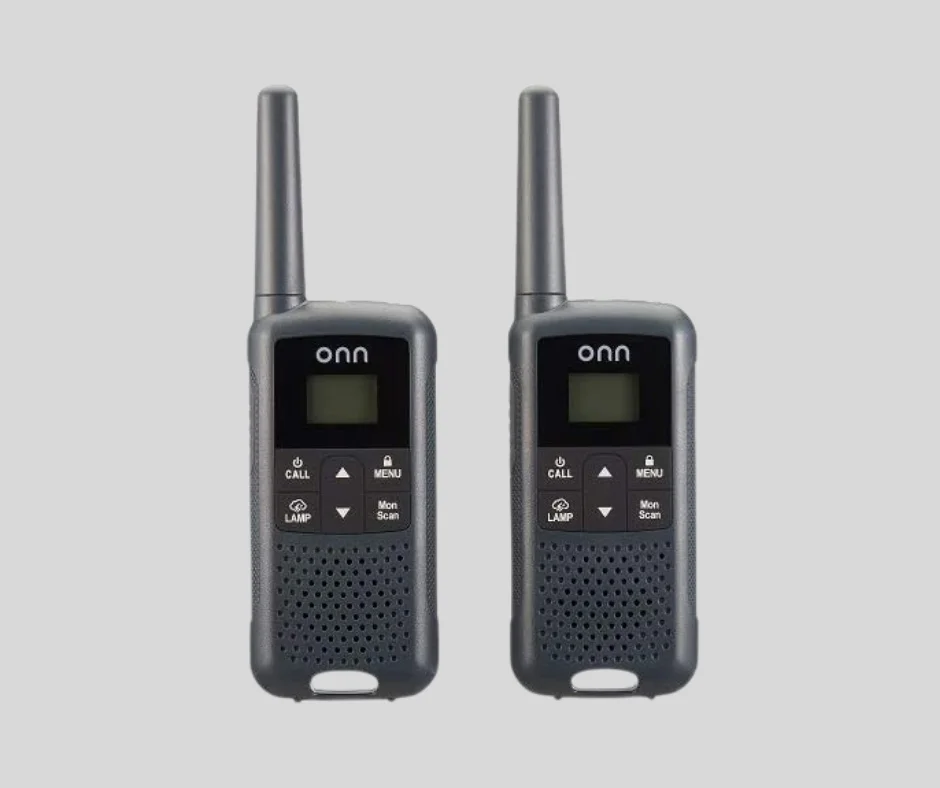
What Is the Onn Walkie Talkie?
Onn is Walmart’s house brand — like Great Value for groceries, but for electronics. The radios are manufactured in China and sold exclusively through Walmart stores and Walmart.com. You won’t find them anywhere else.
The radio itself is a standard FRS unit. FRS — Family Radio Service — is the unlicensed two-way radio band regulated by the FCC. No license required to operate it. Anyone can use FRS radios out of the box.
Key specs on the Onn:
- 22 FRS channels
- 121 privacy codes (CTCSS tones)
- Claimed range: 16 miles (real-world: 0.5-1 mile — more on this below)
- Built-in LED flashlight
- NOAA weather alerts
- Battery: 3x AA alkaline or rechargeable
- Price: ~$25 for a 2-pack at Walmart
It’s not a bad radio for what it is. It’s a bad radio if you expect it to do what the box claims.
Onn Walkie Talkie Manual — How to Use It
The manual that ships with Onn radios is minimal. Here’s what you actually need to know to operate them.
How to turn on and off: Press and hold the power button (top of the radio, same button as PTT on most models) for 2-3 seconds until you hear a tone. Hold it again to power off. Some Onn models have a dedicated power button separate from PTT — check which button has the power icon.
How to change channels: Use the CH +/- buttons on the front face. The channel number displays on the small LCD screen. You and whoever you’re talking to need to be on the same channel — that’s all. Start on channel 1 if you’re setting up fresh.
How to set privacy codes: Press the CODE button and use the +/- buttons to scroll through codes 0-121. Code 0 means no code — you’ll hear anyone on that channel. Codes 1-121 filter out radios on different codes. Note: this filters incoming transmissions only — you’re not actually encrypting anything. Other radios on the same channel can still hear you.
How to enable NOAA weather scan: Press and hold the WX or WEATHER button for 2 seconds. The radio scans through NOAA weather channels and locks onto the strongest signal. Press PTT or any button to return to normal operation.
How to use the LED flashlight: Most Onn models have a dedicated LIGHT button on the side or top. Press once to activate, press again to turn off. The light is functional but not strong — useful for finding something in a dark tent or bag, not for serious illumination.
Battery installation: Remove the battery door on the back (slide down or unscrew depending on model). Insert 3x AA batteries observing polarity markings. Onn radios accept standard alkaline or rechargeable NiMH AA batteries. Battery life with alkaline: approximately 10-12 hours of mixed use.
VOX mode: Some Onn models include VOX (voice-activated transmission). If yours does, hold the MENU VOX hands-free operationgate to VOX settings. VOX sensitivity typically has 3-5 levels — start at medium sensitivity. In noisy environments, turn VOX off and use push-to-talk to avoid false triggers.
Onn Walkie Talkie Range — What to Actually Expect
The box says 16 miles. That number is not a lie exactly — it’s a best-case spec measured in optimal conditions. But it’s also not useful to you.
What you’ll actually get with Onn radios:
- Suburban neighborhood: 0.3-0.5 miles. Houses, trees, and parked cars eat signal.
- Open field: 0.8-1.5 miles with clear line of sight.
- Indoors: 100-300 feet depending on walls and floors. Concrete cuts range significantly.
- Urban / downtown: 0.1-0.3 miles. Buildings block signal aggressively.
If you need reliable range beyond 0.5 miles, Onn won’t deliver consistently. That’s not a defect — it’s the physics of a 2-watt FRS radio. See our breakdown of real walkie talkie range for a full terrain comparison.
Onn Walkie Talkie Frequency Chart
Onn radios use all 22 standard FRS channels. Here’s the full frequency chart including which channels are shared with GMRS and the power limits per channel.
| Channel | Frequency (MHz) | Type | Max Power |
|---|---|---|---|
| 1 | 462.5625 | FRS / GMRS shared | 2W |
| 2 | 462.5875 | FRS / GMRS shared | 2W |
| 3 | 462.6125 | FRS / GMRS shared | 2W |
| 4 | 462.6375 | FRS / GMRS shared | 2W |
| 5 | 462.6625 | FRS / GMRS shared | 2W |
| 6 | 462.6875 | FRS / GMRS shared | 2W |
| 7 | 462.7125 | FRS / GMRS shared | 2W |
| 8 | 467.5625 | FRS only | 0.5W |
| 9 | 467.5875 | FRS only | 0.5W |
| 10 | 467.6125 | FRS only | 0.5W |
| 11 | 467.6375 | FRS only | 0.5W |
| 12 | 467.6625 | FRS only | 0.5W |
| 13 | 467.6875 | FRS only | 0.5W |
| 14 | 467.7125 | FRS only | 0.5W |
| 15 | 462.5500 | FRS / GMRS shared | 2W |
| 16 | 462.5750 | FRS / GMRS shared | 2W |
| 17 | 462.6000 | FRS / GMRS shared | 2W |
| 18 | 462.6250 | FRS / GMRS shared | 2W |
| 19 | 462.6500 | FRS / GMRS shared | 2W |
| 20 | 462.6750 | FRS / GMRS shared | 2W |
| 21 | 462.7000 | FRS / GMRS shared | 2W |
| 22 | 462.7250 | FRS / GMRS shared | 2W |
Channels 8-14 are FRS-exclusive at 0.5 watts — GMRS radios cannot use these. Channels 1-7 and 15-22 are shared between FRS and GMRS at up to 2 watts. Privacy codes (CTCSS tones) work across all 22 channels. For the full breakdown of how FRS and GMRS interact, see the FRS channel guide.
Is the Onn Walkie Talkie Worth Buying?
Honest answer: it depends on what you’re doing with it.
Onn is a reasonable pick if:
- Kids in the backyard or neighborhood
- One-day event where you need basic comms
- You’re on a tight budget and staying within 0.5 mile
- Indoor use — warehouse, event venue, shopping
Onn is the wrong radio if:
- Hiking, camping, or any outdoor activity beyond a short walk
- Emergency preparedness — build quality and reliability are not there
- Anything requiring range beyond a parking lot
- Frequent use — the build doesn’t hold up to daily wear
One thing worth mentioning: if outdoor performance matters at all, Rocky Talkie makes a purpose-built FRS radio designed specifically for outdoor and backcountry use. It costs significantly more than Onn — but it’s waterproof, built for cold temperatures, and actually performs at its claimed range in mountain terrain. Onn and Rocky Talkie aren’t competing for the same buyer, but it’s the right reference point if you’re trying to understand where Onn sits on the spectrum.
Check current Onn walkie talkie price
Frequently Asked Questions
How do you use an Onn walkie talkie?
Power on by holding the top button 2-3 seconds until you hear a tone. Set both radios to the same channel using the CH +/- buttons. Set matching privacy codes if you want to filter other nearby radios. Press and hold the PTT (push-to-talk) button on the side to transmit — release to receive. Make sure both radios are on the same channel and code. That’s it. The LED flashlight and NOAA weather scan are secondary functions accessible via dedicated buttons.
How do I turn on an Onn walkie talkie?
Press and hold the power button for 2-3 seconds. On most Onn models this is the top button — the same one used for PTT on some versions, or a separate button marked with a power icon. You’ll hear a startup tone and the LCD screen will light up showing the current channel. To power off, press and hold the same button again until you hear the shutdown tone. If nothing happens, check that batteries are installed correctly — Onn radios require 3x AA batteries.
What channels does the Onn walkie talkie use?
Onn walkie talkies use all 22 standard FRS channels ranging from 462.5625 MHz to 467.7125 MHz. Channels 1-7 and 15-22 are shared with GMRS radios and operate at up to 2 watts. Channels 8-14 are FRS-exclusive at 0.5 watts. You can communicate with any FRS or GMRS radio on the same channel regardless of brand — Onn works with Motorola, Midland, Retevis, and any other FRS radio.
How far does the Onn walkie talkie actually reach?
In real conditions: 0.3 to 1 mile. The 16-mile range claim on the box is measured in ideal open conditions with elevated antennas — it’s a technical spec, not a practical one. In a suburban neighborhood expect 0.3-0.5 miles. In an open field with clear line of sight you might get 1-1.5 miles. Indoors, figure on 100-300 feet per floor depending on construction materials. At 2 watts FRS power, this is normal — not a defect with Onn specifically.
Where can I find the Onn walkie talkie manual?
The official manual PDF is filed with the FCC under device ID 2APXNLWT001 at fcc.gov — search that ID in the FCC equipment authorization database and look for the user manual exhibit. The key functions are covered above: power on/off, channel selection, privacy codes, NOAA weather scan, LED flashlight, and VOX mode. The physical manual included in the box covers the same material with diagrams of the button layout.
Is the Onn walkie talkie worth buying?
For casual, short-range use — kids, backyard, single-day events, indoor coordination — yes at $25 it’s acceptable. You’re not getting a durable or high-performance radio, but it works for basic push-to-talk communication within half a mile. It’s not worth buying for outdoor activities, hiking, camping, or emergency use — the build quality and range reliability aren’t there. If you need something one step better at the same price, the Midland T10 or Motorola T100 both outperform Onn without costing significantly more.