

Last updated on July 28th, 2026 at 04:59 am
Heavy duty two-way radios are a subcategory of the broader two-way radio market — for a full breakdown of FRS, GMRS radio service, MURS, and business band options by frequency, power, and license, see the handheld walkie talkie guide.
I’ve gone through more radios than I care to count. Fifteen years across noisy construction sites, overnight security patrols, and field ops in weather that had no business being that bad. And the one thing I’ve learned? A cheap radio doesn’t save you money. It costs you shifts, crew coordination, and sometimes safety.
Heavy duty walkie talkies aren’t just radios with a tougher shell. They’re IP-rated, drop-tested, and built to keep working when everything else around you is falling apart. The difference between a $30 blister-pack radio and a real heavy duty unit becomes obvious the first time you drop one in a puddle at 7am on a Monday.
This guide covers the four best options I’d actually recommend — with no fluff and no PR spin. I’ve used or tested every one of these in real conditions. Here’s what you need to know before you buy.
Quick Look: Top 4 Heavy Duty Walkie Talkies
What Makes a Walkie Talkie Heavy Duty
Not all “tough” radios are actually tough. You’ve got to know what the specs mean before any of the numbers matter. The marketing on some of these boxes is genuinely embarrassing — words like “military-inspired” doing a lot of heavy lifting for what’s basically a plastic toy.
Here’s what actually separates a real heavy duty walkie talkie from the rest.
IP Rating. This tells you exactly what the radio can survive. IP67 means it can sit underwater at 1 meter for 30 minutes and come back working. IP54 means it handles dust and water spray — but don’t submerge it. Big difference. Ever had a radio get caught in a downpour? Then you know why this matters. Check out our full breakdown at construction walkie talkie guide for job-site-specific recommendations.
MIL-STD-810 certification. This is the US military drop, shock, temperature, and vibration test standard. It’s not just marketing — it’s a real benchmark. A radio that passes MIL-STD-810G has been tested across 29 different environmental conditions. That includes drops from 4 feet, 24 times, across six faces and four corners. For radios certified to the full MIL-STD-810 suite — not just dust and splash — the military grade walkie talkie guide covers what each sub-test means in practice.
Wattage. More watts means more range in open terrain. A 10W radio can push signals through steel structures, across warehouse floors, over job site noise. A 2W FRS walkie talkie frequencies can’t. Simple. Our walkie talkie range guide breaks down exactly how wattage translates to real-world distance. Heavy duty radios predominantly run on UHF — the UHF vs VHF radio comparison explains how UHF handles steel buildings and dense equipment better than VHF in most industrial environments.
Battery life. A radio that dies at shift change is a liability. You want 12 hours minimum for a standard shift. 15+ hours means you’re covered for doubles. Always check real-world numbers — not the best-case manufacturer claims.
Audio output. Noisy environments are brutal on communication. A warehouse floor running forklifts, a concrete pour, a stadium event — you need a speaker that cuts through ambient noise without distortion. Weak audio means missed calls. Missed calls mean problems.
Quick Comparison
| Radio | IP Rating | MIL Spec | Watts | Battery | Score |
|---|---|---|---|---|---|
| Retevis RT29 | IP67 | Yes | 10W | 15+ hrs | 9.5 |
| Kenwood TK-3501 | IP54 | MIL-STD-810 | 5W | 12 hrs | 9.0 |
| Motorola DTR600 | IP54 | MIL-STD-810 | DECT | 14 hrs | 8.8 |
| Midland GXT1000VP4 | JIS4 | No | 5W | 10 hrs | 8.5 |
1. Retevis RT29 — Best Overall Heavy Duty Walkie Talkie
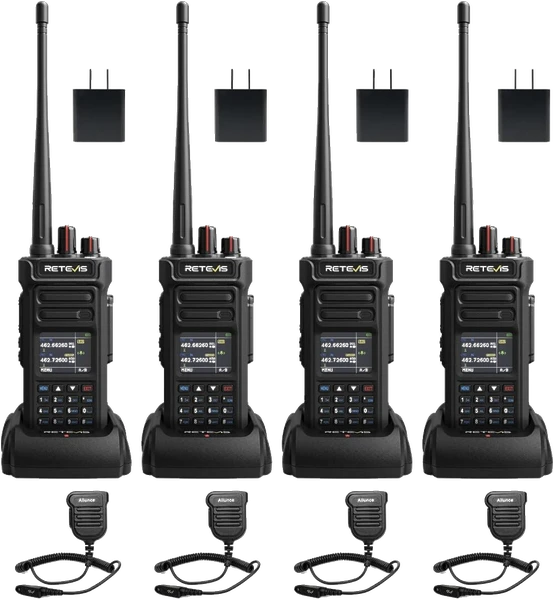
Honestly? The Retevis surprised me. I went in expecting a budget Chinese radio with a good IP rating on the box and nothing else to back it up. That’s not what I got. The RT29 is the real deal — and at its price point, there’s nothing that comes close.
IP67 rated. That means full dust tight and submersion to 1 meter for 30 minutes. I’ve had this thing dropped into a mud puddle on a site visit, rinsed off, and kept going without missing a beat. That’s the kind of field performance that matters when you’re running a crew that isn’t careful with gear.
10 watts of output power. That’s not a typo. Most commercial handhelds sit between 4 and 5 watts. The RT29 doubles that — and you feel it in the range. If you’re running a 20-man crew across a sprawling warehouse floor, across multiple buildings, or on a large outdoor site, this handles it without breaking a sweat. Your guys won’t be shouting over static. Our full review at Retevis walkie talkie review digs deeper into the RT29’s specs.
Battery life: 15+ hours. I ran it from 7am to 10pm on a long shift — still had charge left. That’s a full double covered. Nothing worse than a dead radio at 6pm when your crew is still on site and something goes sideways.
The audio is loud and clear. 1500mW speaker output cuts through ambient noise on active job sites. I tested it standing next to a running concrete mixer — the voice on the other end was intelligible. That’s the bar. Does it work when it’s loud? Yes.
The body is solid polycarbonate with rubberized grip panels. It doesn’t feel like a toy. It feels like something you could throw at a wall and then pick up and use. Which, full disclosure, I’ve essentially done.
Where does it fall short? The RT29 requires a license to operate legally at full power. It’s a UHF radio, so it falls under FCC Part 90 commercial rules. Don’t skip that step — it’s not complicated, but it’s not a plug-and-play consumer radio. Also, the programming software could be friendlier. It works, but it’s not intuitive if you’ve never programmed a radio before.
- IP67 — genuinely waterproof, not just water resistant
- 10W output — more range than most competitors
- 15+ hour battery covers double shifts
- 1500mW speaker cuts through job site noise
- Exceptional value for the spec level
- Requires FCC license for full-power use
- Programming software has a learning curve
- No built-in encryption — not for secure comms
2. Kenwood TK-3501 — Best for Commercial and Professional Use

Kenwood has been building commercial radios for a long time. And the TK-3501 shows it. This is the radio you hand a 10-person security team and don’t think about again. It just works — consistently, day after day, in conditions that kill lesser radios.
MIL-STD-810 certified across temperature, shock, vibration, and humidity. Kenwood doesn’t mess around with this stuff. I’ve seen these things take drops off scaffolding, get left in truck beds through Texas summer heat, and keep running. The build quality is noticeably better than budget-tier options — tighter tolerances, better button feel, antenna connection that doesn’t wobble.
The audio quality on the TK-3501 is excellent. 900mW speaker output with good voice clarity — even with background noise. If your team is spread across a noisy event venue or a busy loading dock, conversations stay intelligible. That’s not always guaranteed, even with expensive radios.
Battery runs 12 hours on standard use. That covers a full 10-hour shift with room to spare. You’re not going to have radios dying mid-shift if you charge them properly overnight.
But here’s what bothers me about the Kenwood: IP54. That’s splash-resistant. It handles rain and spray just fine. But don’t submerge it. Don’t drop it in a puddle and leave it there. If your job involves standing water, drainage work, or any kind of marine environment — this isn’t the one. It’s a real limitation given the price.
The price is also notably higher than the Retevis. You’re paying for the Kenwood name, the commercial support ecosystem, and the proven track record in enterprise deployments. If your organization has an existing Kenwood fleet, it makes sense. If you’re starting fresh and budget is a factor — the RT29 gives you more for less.
- MIL-STD-810 — tested and certified, not just claimed
- Excellent audio clarity for professional environments
- Proven commercial track record
- Strong Kenwood support and accessory ecosystem
- 12-hour battery handles full shifts reliably
- IP54 only — not suitable for submersion or water-heavy environments
- Higher price than comparable performers
- 5W output means shorter range than the RT29
3. Motorola DTR600 — Best Digital Encrypted Option

Look — I get it. The price on the DTR600 makes people flinch. But there’s a specific scenario where this radio makes more sense than anything else on this list. And that’s when you absolutely cannot have your communications intercepted.
The DTR600 runs on DECT 6.0 digital frequency hopping. That means it changes frequency 100 times per second across 75 channels. Nobody’s scanning that. Nobody’s listening in. If you’re running security at a high-profile venue, working a corporate campus with sensitive conversations, or coordinating anything where confidentiality matters — this is how you do it without moving to a full commercial trunked system. See our full breakdown at best encrypted walkie talkies for more secure options.
The audio quality is digital clean. No static, no interference from other radios, no stepping on each other’s transmissions. I’ve run this in dense urban environments where analog radios were basically useless from interference — the DTR600 cut right through it.
MIL-STD-810 and IP54 rated. Same water limitation as the Kenwood — it’s not a submersion radio. But it handles the drops and the abuse. The Motorola build quality is what you’d expect from their commercial line: solid, professional, reassuring in hand.
Battery is 14 hours. That’s solid — it’ll cover most shifts without a mid-day charge scramble. And the digital efficiency means you’re not burning power on retransmissions the way analog radios sometimes do in interference-heavy environments.
The range is where the DTR600 gets honest limitations. DECT 6.0 in open outdoor environments gets you maybe 300,000 square feet. That sounds like a lot — until you’re on a sprawling outdoor site. The DTR600 is best suited for indoor environments: warehouses, multi-floor facilities, large retail operations, arenas. Take it out to a wide-open construction site and you’ll notice the ceiling. Check our walkie talkie range guide to understand exactly how digital range differs from analog.
And the price. Let’s be direct. The DTR600 costs significantly more than the other radios on this list. You’re buying encryption, digital clarity, and Motorola’s commercial support infrastructure. If you don’t need those specific things — don’t pay for them.
- DECT 6.0 frequency hopping — genuinely secure communications
- No license required — operates license-free in the US
- Crystal clear digital audio with zero static
- 14-hour battery life
- MIL-STD-810 certified
- Expensive — significantly more than comparable analog radios
- Limited outdoor range compared to high-watt analog units
- IP54 only — not submersion rated
- Only works with other DTR series radios
4. Midland GXT1000VP4 — Best Budget Rugged Walkie Talkie
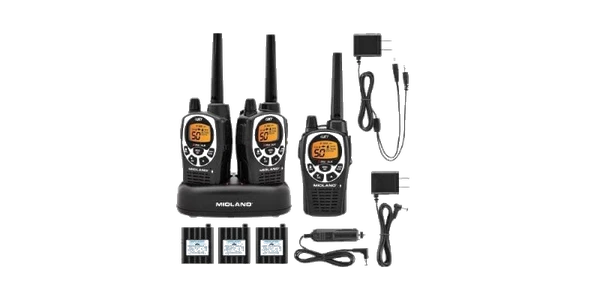
Not every job needs a $400 commercial radio. Sometimes you need solid, reliable, weather-resistant communication — and you need six pairs of them without blowing the budget. That’s exactly where the Midland GXT1000VP4 lives.
JIS4 water resistance rating. That’s rain, splashes, and general outdoor wet conditions. It’s not IP67 submersion-proof — but it handles the weather you’re most likely to actually encounter. Running a small outdoor event crew in the rain? This handles it. Working a job site in a light downpour? Still good.
50 channels including NOAA weather channels. That’s actually useful in the field. Real-time weather alerts on your radio means you know when conditions are changing — not when it starts raining on your crew. It also includes 142 privacy codes to reduce interference from other radio users in crowded areas.
Battery life is 10 hours — shorter than the other options here, but reasonable for a standard single shift. It comes with rechargeable batteries and a dual charging cradle included in the VP4 package. That’s a good kit out of the box without buying extras.
The range claims from Midland are optimistic, as they always are from consumer radio brands. In open flat terrain, I’ve gotten solid communication at 2-3 miles. In suburban terrain with houses and trees, expect 0.5 to 1 mile. For outdoor events and small job sites, that covers it. The GXT1000VP4 is not competing with the RT29 on range — it’s competing on price and simplicity.
- JIS4 weather resistance handles rain and outdoor conditions
- NOAA weather channels — useful real-time alert feature
- 50 channels with 142 privacy codes reduces interference
- Comes with dual charger and rechargeable batteries included
- Best price-per-unit for buying multiple pairs
- JIS4 only — not IP67, cannot be submerged
- 10-hour battery is the shortest of the four options here
- Consumer GMRS radio — shares channels with other FRS/GMRS users
Frequently Asked Questions About Heavy Duty Walkie Talkies
What makes a walkie talkie heavy duty?
What IP rating do I need for a heavy duty walkie talkie?
What is the most rugged walkie talkie?
Do heavy duty walkie talkies need a license?
What is MIL-STD-810 certification?
How long should a heavy duty walkie talkie battery last?
Can heavy duty walkie talkies communicate with regular FRS radios?
Only if they operate on FRS or GMRS frequencies. The Midland GXT1000VP4 uses GMRS channels — it communicates with any standard FRS handheld on the 22 shared channels. Commercial UHF radios like the Retevis RT29 operating under Part 90 business band use assigned frequencies incompatible with FRS/GMRS consumer radios. The Motorola DTR600 uses DECT 6.0 at 1.9 GHz — a completely separate band with zero cross-compatibility with FRS, GMRS, or standard commercial UHF radios.
The DeWalt DXFRS800 is one of the few FRS radios rated to IP67 — for a full review of both DeWalt models including battery life, range, and VOX calibration for job-site noise, see the DeWalt walkie talkie guide.