

Last updated on July 28th, 2026 at 04:59 am
The DeWalt DXFRS800 is the best DeWalt walkie talkie for most job sites. It runs on FRS frequencies — no license required — with IP67 waterproofing, 20-hour battery life on standard AA batteries, VOX hands-free transmission, and NOAA weather alerts. Real-world range is 0.5 to 1 mile on a busy job site. The DXFRS300 is the crew-scale option — it comes in 6-packs with rechargeable batteries and is better suited to large teams working in close proximity. Neither model is compatible with GMRS radio service or business band radios — they operate on FRS channels only.
I’ve used DeWalt radios on construction sites where the alternative was shouting across a concrete pour. The DXFRS800 specifically earned its place in my kit because it does what most job-site radios don’t: it works in the rain, takes a drop off a scaffold deck, and still has battery at the end of a double shift. That’s a short list.
DeWalt makes two walkie talkie models — the DXFRS800 and the DXFRS300. This guide covers both with real specs and honest assessments of where each one works and where it doesn’t. For a full breakdown of all handheld radio types including GMRS and business band, see the handheld walkie talkie guide.
DeWalt Walkie Talkies at a Glance
What Makes DeWalt Walkie Talkies Different
Most consumer walkie talkies are designed for weekend hiking. DeWalt’s DXFRS800 and DXFRS300 are designed for contractors. That’s not just a marketing claim — it shows up in specific hardware decisions that matter on a real job site.
IP67 waterproofing on both models. That means fully dustproof and submersible to 1 meter for 30 minutes. You can drop it in a puddle, rinse it off, and keep going. Compare that to the IP54 rating on most competitor job-site radios — IP54 handles spray and rain but won’t survive a full submersion. On a site where water is a constant — concrete work, plumbing, outdoor excavation — IP67 is the minimum you should accept. For more on what IP ratings mean in practice, the heavy duty walkie talkie guide covers IP54 vs IP67 vs IP68 in detail.
FRS frequency band, no license required. Both models operate on the 22 shared FRS/GMRS channels in the 462–467 MHz UHF band. FRS is license-free — you can hand a radio to a subcontractor and they can use it immediately without paperwork. The tradeoff is that FRS channels are shared with every other radio in range. CTCSS privacy codes (142 options on both models) filter who you hear, but they don’t give you a private channel — they just mute transmissions using a different code. The CTCSS privacy codes guide explains how that works and where it helps.
AA batteries on the DXFRS800. This is a practical job-site advantage. When the battery dies mid-shift, you don’t wait for a charger — you swap AAs. You can buy batteries at any hardware store on the way to the site. No proprietary battery packs, no charging schedules, no dead radios because someone forgot to plug in. The DXFRS300 uses rechargeable packs — better for predictable daily-cycle crews, but a liability when you need a radio right now and the charger is across the site.
VOX hands-free transmission. When you’re operating equipment, mixing concrete, or carrying materials, pressing a PTT button isn’t always possible. VOX activates transmission when you speak and cuts when you stop. Both DeWalt models include adjustable VOX sensitivity — critical for job sites where background noise would otherwise trigger constant false transmissions. The VOX guide covers sensitivity calibration for noisy environments.
Quick Comparison
| Model | Power | IP Rating | Battery | Range | Best For |
|---|---|---|---|---|---|
| DXFRS800 | 2W (Ch 1–7/15–22), 0.5W (Ch 8–14) | IP67 | AA batteries (20 hrs) | 0.5–1 mile job site | Individual use, long shifts |
| DXFRS300 | 1W | IP67 | Rechargeable (10 hrs) | 0.3–0.8 mile job site | Large crews, 6-pack deployment |
1. DeWalt DXFRS800 — Best Overall
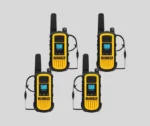
The DXFRS800 is the radio DeWalt actually got right. It covers the things job-site radios need to cover: waterproofing that isn’t just a claim, battery life that outlasts the shift, and audio output loud enough to cut through active construction noise.
IP67 certification means it’s fully dustproof and survives 1-meter submersion for 30 minutes. That’s a real spec, not “water-resistant” marketing language. I’ve had this radio go through morning dew, rain, and a concrete mixer splash-zone — never failed. The housing is reinforced over the key stress points — corners, belt clip mount, antenna base — where job-site radios typically fail first.
Battery life is the DXFRS800’s strongest feature. Running on standard AA batteries, DeWalt rates it at 20 hours. Real-world on a normal transmit/receive ratio across a 10-hour shift, I’ve consistently had significant charge left. When it runs low, you swap AAs — no charger required, no proprietary pack, no waiting. That matters more than it sounds when you’re on a site with 12 guys and four working radios.
2 watts on channels 1–7 and 15–22. FRS caps at 2W on those channels, so the DXFRS800 is running at the legal FRS maximum. On channels 8–14, it drops to 0.5W per FRS regulations. In practice, this means your real-world range on a job site with steel, concrete, and equipment interference is 0.5 to 1 mile. DeWalt’s marketing claims 300,000 sq ft — roughly the equivalent of a large warehouse floor. That’s achievable under ideal interior conditions. On a multi-building site with obstructions, plan for less. The walkie talkie range guide covers exactly how building materials and terrain affect FRS signal.
NOAA weather channels are included — all 11 weather broadcast channels with alert tone. On an exterior job site, knowing a storm is coming 30 minutes out is operationally useful. You’re not hunting for a phone signal while operating equipment. The radio just broadcasts the alert.
VOX is adjustable across three sensitivity levels. Low sensitivity requires louder speech before triggering — better for noisy environments where ambient sound would otherwise activate it constantly. High sensitivity captures quieter speech but may trip on background noise. The middle setting works for most job-site conditions. Take five minutes to test it against your site’s ambient noise before deploying.
- IP67 — fully dustproof, submersion-rated to 1 meter
- 20-hour battery on standard AAs — no charger dependency
- 2W on main FRS channels — maximum allowed power
- NOAA weather alerts — all 11 channels with alert tone
- Adjustable VOX with 3 sensitivity levels
- 142 CTCSS/DCS privacy codes
- Built to DeWalt’s TOUGH SYSTEM housing standard
- FRS only — no GMRS channels, no repeater access
- Shared FRS channels mean interference from other users
- 0.5W on channels 8–14 — FRS regulatory limit
- No backlit display for low-light environments
2. DeWalt DXFRS300 — Best for Large Crews
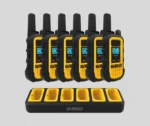
The DXFRS300 is the same IP67 housing as the DXFRS800, scaled down to 1W output and rechargeable battery operation. It exists specifically because large crews need cost-effective multi-unit deployment. The DXFRS300BCH6 variant comes as a 6-pack with a multi-unit charger — you charge all six overnight and deploy them in the morning.
IP67 waterproofing carries over from the DXFRS800 — same rating, same real-world durability. The housing is DeWalt’s TOUGH SYSTEM polycarbonate, drop-tested for construction environments. If you’re buying six of these and handing them to a crew of mixed experience levels, the housing holds up to the kind of treatment tools get on an active site.
1W output means shorter range than the DXFRS800. On a compact job site — a single building floor, a warehouse, a retail space under construction — 1W covers it. On a multi-acre site or across buildings, you’ll notice the gap. If your crew needs more than 0.5 miles of reliable coverage, buy DXFRS800s instead. The per-unit cost difference is worth it for the range.
The rechargeable battery is the DXFRS300’s main operational tradeoff. 10 hours on a full charge is a standard shift — barely. Add double shifts or late-start charging and you’re managing battery rotation. The multi-unit charger in the 6-pack bundle helps, but you’re committed to a charging routine. The DXFRS800’s AA approach is more flexible for unpredictable schedules.
Same 22 FRS channels, 142 CTCSS privacy codes, VOX — all present. NOAA weather alerts are also included. Functionally identical to the DXFRS800 on the feature list, just running at half the power and on a different battery system.
- IP67 waterproofing — same spec as DXFRS800
- 6-pack variant (DXFRS300BCH6) with multi-unit charger
- Lower cost per unit for large crew deployment
- Full FRS feature set — VOX, CTCSS, NOAA
- Compact form factor — lighter than DXFRS800
- 1W output — shorter range than DXFRS800
- 10-hour rechargeable battery — tight for double shifts
- Requires charging discipline — no AA backup option
DXFRS800 vs DXFRS300 — Which One to Buy
Both radios share the same core spec: IP67, FRS frequencies, 22 channels, 142 privacy codes, VOX, NOAA. The decision comes down to three variables.
Shift length and battery flexibility. If your shifts run 10+ hours or vary unpredictably, the DXFRS800’s AA battery operation gives you more control. 20 hours of rated life means you’re not managing charging schedules. If your crew works predictable shifts and charges overnight, the DXFRS300’s rechargeable system is cleaner operationally.
Crew size and coverage area. For 1–4 people on a compact site, buy DXFRS800s. For 5+ people working in close proximity, the DXFRS300 6-pack is the more cost-effective option. If your crew covers more than 0.5 miles of separation, the DXFRS800’s 2W output is the minimum you should accept.
Budget. The DXFRS300 6-pack bundle brings the per-unit cost down significantly. If you’re equipping a large crew and the range requirement is modest, the cost difference adds up fast. For most construction site applications where the DXFRS300’s 1W is sufficient, the 6-pack is the practical choice.
Both models operate on FRS frequencies only. They can communicate with any FRS or GMRS radio on the 22 shared channels — including radios from other brands. They cannot access GMRS repeater channels or business band Part 90 frequencies. If your operation requires more than 1 mile of coverage or exclusive channel access, GMRS or business band hardware is the upgrade path. The FRS and GMRS frequency guide covers how those channel structures differ.
Frequently Asked Questions About DeWalt Walkie Talkies
Do DeWalt walkie talkies need a license?
No. Both the DXFRS800 and DXFRS300 operate on FRS frequencies, which are license-free. You can use them out of the box without registering with the FCC. They share the 22 FRS/GMRS channels with any other FRS or GMRS radio, but no license is required to transmit. If you need the higher power or repeater access that GMRS offers, a $35 FCC license unlocks those capabilities — but DeWalt’s radios are FRS-only and don’t support GMRS repeater channels.
What is the actual range of the DeWalt DXFRS800?
DeWalt rates the DXFRS800 for up to 300,000 sq ft, which is roughly equivalent to a large warehouse floor under ideal line-of-sight conditions. On a real job site with steel framing, concrete walls, active equipment, and multiple floors, expect 0.5 to 1 mile. In open flat terrain with no obstructions, you can push beyond that. The 2W FRS output is the legal maximum for FRS channels 1–7 and 15–22 — range performance is consistent with other 2W FRS radios in comparable environments.
Can DeWalt walkie talkies communicate with other brands?
Yes, on any of the 22 shared FRS/GMRS channels. A DeWalt DXFRS800 communicates with Motorola, Midland, Retevis, or any other FRS or GMRS radio set to the same channel and matching CTCSS code. They operate on standard FRS frequencies — there’s nothing proprietary about the channel structure. What they can’t do is access GMRS-only repeater channels (channels 15R–22R) that require a GMRS license and dedicated hardware.
What batteries does the DeWalt DXFRS800 use?
The DXFRS800 runs on 4 standard AA batteries. DeWalt rates battery life at 20 hours. This is a deliberate design choice for job-site use — when the radio runs low, you replace AAs rather than waiting for a proprietary pack to charge. Standard AA alkalines work fine. Lithium AAs extend life further and perform better in cold weather below freezing, where NiMH cells lose capacity significantly.
Is the DeWalt DXFRS800 really IP67 waterproof?
Yes. IP67 means fully dustproof (6) and submersion-rated to 1 meter for 30 minutes (7). DeWalt had the DXFRS800 independently tested to this standard. It’s not “water-resistant” or “splash-proof” marketing language — IP67 is a defined IEC standard with specific test procedures. In practice, it handles rain, job-site washdowns, and accidental drops in puddles without failure. If you need deeper or longer submersion protection, IP68 is the next level up.
What is the difference between DXFRS800 and DXFRS300?
Three main differences: power output (2W vs 1W), battery system (AA alkaline vs rechargeable), and intended scale. The DXFRS800 runs at the full FRS power limit on main channels, lasts 20 hours on AAs, and suits individual or small-team use. The DXFRS300 runs at 1W, uses a rechargeable pack (10-hour life), and is designed for multi-unit crew deployment — particularly the 6-pack DXFRS300BCH6 bundle with a shared charger. Both carry IP67 waterproofing and the same feature set otherwise.
What channel should I use for DeWalt walkie talkies on a job site?
Start on channel 1 or 2 with a CTCSS code that matches across your crew’s radios. Channels 1–7 and 15–22 transmit at the full 2W FRS power limit — stay on these for maximum range. Channels 8–14 are capped at 0.5W per FCC rules. If you’re getting interference from other users on your chosen channel, switch channels rather than changing the privacy code — you’re still sharing the RF spectrum regardless of code. The FRS and GMRS channel chart shows the full 22-channel breakdown with power limits per channel.