

Last updated on July 16th, 2026 at 06:48 pm
DAB radio (Digital Audio Broadcasting) delivers cleaner sound and more station choice than FM by transmitting audio as a compressed digital signal. It is the dominant radio standard across the UK, most of Europe, and Australia — but DAB is not used in the United States. US listeners use HD Radio instead, a different digital standard that broadcasts on existing FM frequencies.
The confusion around DAB radio is real. Walk into any UK electronics store and DAB is the default. Search Amazon in the US and you will find DAB radios listed alongside HD radios with no explanation of the difference. Most articles about DAB were written for a UK audience, which does not help if you are trying to understand the technology from a US or international perspective.
This guide covers what DAB radio actually is, how it compares to FM, why the US went a different direction, and what that means for buying a radio today. For a broader look at radio technologies from walkie talkies to CB to digital, the guide to types of radio covers the full spectrum.
What Is DAB Radio and How Does It Work?
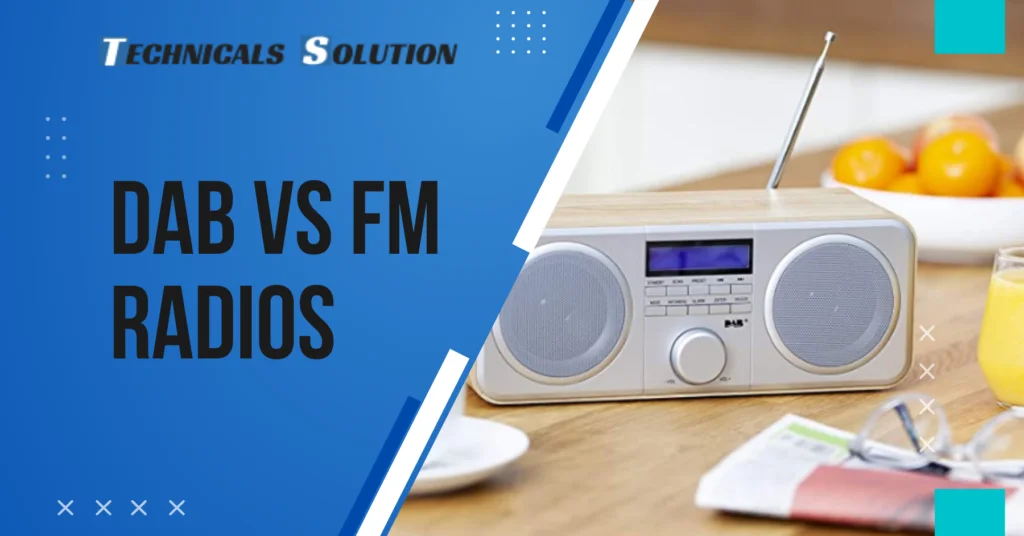
DAB stands for Digital Audio Broadcasting. Instead of transmitting an analog FM signal that degrades over distance, DAB transmits audio as a digital stream using OFDM — Orthogonal Frequency Division Multiplexing — the same modulation technique behind WiFi and 4G. The signal either arrives cleanly or it does not arrive at all. No crackling. No static. No fade. You get clear audio right up to the edge of the coverage zone, then silence.
DAB operates in Band III (174–240 MHz) in most countries. The UK primarily uses Band III. Multiple radio stations are bundled together into a single “multiplex” — one transmission stream that carries 10 to 20 stations simultaneously. Your radio tunes to the multiplex and extracts the station you want. This is why DAB can offer far more stations than FM from a single transmitter site: one FM frequency carries one station; one DAB multiplex carries a dozen.
The original DAB standard launched in the UK in 1995. It used MPEG-1 Audio Layer II compression — adequate for 1995, mediocre by modern standards. DAB+ (Digital Audio Broadcasting Plus), introduced in 2007, replaced that codec with HE-AAC (High-Efficiency Advanced Audio Coding). HE-AAC is roughly twice as efficient, which means DAB+ stations sound significantly better at the same bitrate, and multiplexes can carry more stations in the same bandwidth. All radios sold as “DAB” since around 2010 support both standards. If you are buying second-hand, check for explicit DAB+ support — original DAB radios cannot decode DAB+ streams.
DAB vs FM Radio: The Real Differences
The comparison between DAB and FM is not as simple as “digital is better.” Both have genuine strengths depending on your situation.
| Feature | DAB Radio | FM Radio |
|---|---|---|
| Signal type | Digital (OFDM) | Analog (frequency modulation) |
| Audio quality | Consistent, no static; bitrate-dependent | High-fidelity at strong signal; degrades with distance |
| Station count | 30–50+ per multiplex area | Typically 15–30 local stations |
| Urban coverage | Excellent; multipath resistant | Good; multipath interference possible |
| Rural coverage | Gaps common in remote areas | Near-universal; 70 years of infrastructure |
| Fringe reception | Cliff-edge: clean signal or nothing | Degrades gradually (static, hiss) |
| Battery use | Higher than FM (DAB+ improved over DAB) | Lower power draw |
| Station info display | Station name, song title, programme data | RDS: basic station name + song title only |
| Availability in US | Not available | Universal |
| Receiver cost (UK) | £20–£200+ | £10–£50 for a basic set |
The most common complaint about original DAB is audio quality. Many UK stations broadcast at 128kbps MP2 — which is audibly worse than a strong FM signal for music. DAB+ at 128kbps HE-AAC is significantly better. If you are buying a DAB radio today, confirm it supports DAB+ and that your local stations broadcast in DAB+. In the UK, most new national stations launch as DAB+ only. Older stations on original DAB at low bitrates can sound noticeably worse than FM — that is a broadcast infrastructure problem, not a hardware problem.
Is DAB Radio Available in the US?
No. DAB radio is not broadcast in the United States. The US uses HD Radio — also called IBOC (In-Band On-Channel) — as its digital radio standard. HD Radio is fundamentally different from DAB: instead of using a dedicated frequency band, it squeezes a digital signal into the same FM or AM frequencies already in use. Your car receives HD Radio on a standard FM frequency — the digital signal rides alongside the analog signal invisibly.
Why did the US not adopt DAB? Primarily because of existing infrastructure. US radio stations had decades of investment in FM. HD Radio let them add digital broadcasting without rebuilding transmitter networks or relocating to new spectrum. The FCC authorized HD Radio in 2002. DAB would have required allocating entirely new spectrum bands and building new transmitter infrastructure across the country — a cost no US broadcaster was willing to absorb.
If you buy a DAB radio on Amazon in the US, the DAB tuner will not work. Band III frequencies (174–240 MHz) are allocated to television broadcasting in the US, not radio. You will have a device with a useless DAB tuner. Some imported DAB radios include an FM tuner — that will work fine in the US. But the DAB function is inoperable without travelling to a DAB coverage country. For a full breakdown of what the different radio frequency bands are used for in North America, the radio frequency guide covers the spectrum allocations relevant to US listeners.
Advantages of DAB Radio Over FM
For listeners in DAB coverage areas, the practical advantages over FM are real:
No frequency tuning. You select a station by name from a list, not by scanning a dial. The radio displays all available stations on the multiplex. No more hunting for a specific frequency in an unfamiliar city or when the car drifts between transmitter coverage zones.
More stations. The UK national DAB multiplex carries over 20 national stations. Add regional multiplexes and you have access to 40+ stations from a single indoor antenna. The difference is most noticeable for specialist formats — jazz, classical, spoken word, news talk — that are commercially unviable on FM but sustainable on DAB with lower distribution costs.
Programme data. DAB broadcasts PAD — Programme Associated Data — including station name, song title, artist, programme description, and in some cases scrolling news text. FM RDS offers limited station ID and song data only. For listeners who want context on what they are hearing without reaching for a phone, DAB is meaningfully better.
Urban multipath resistance. FM can suffer multipath interference in dense cities — signal reflections off buildings creating ghost signals and distortion. DAB’s OFDM modulation was specifically designed to handle multipath interference. Urban reception is generally more stable and consistent on DAB than FM, particularly in underground car parks, shopping centres, and areas surrounded by high-rise buildings.
In-car upgrades. Many cars manufactured before 2015 have FM-only head units. DAB adapter kits — which plug into the existing aerial socket and add a DAB tuner — are widely available in the UK from around £30 to £80. They rebroadcast the DAB signal on an unused FM frequency so the standard head unit receives it without modification. It is not audiophile-grade, but it works. Replacement DAB-native head units are the cleaner solution if you are already changing the stereo.
When FM Is Still Better Than DAB
DAB is not the right answer in every situation. FM holds real advantages in several common use cases.
Rural coverage. DAB coverage in the UK is excellent in cities and along major roads. In remote rural areas — particularly in Scotland, Wales, and Northern Ireland — DAB coverage drops sharply. FM transmitters have been in place for 70 years with near-universal coverage. If you are frequently in the countryside, check DAB coverage for your specific area before assuming it will work reliably. FM is the safer default for rural listeners.
Portable battery life. A portable DAB radio draws significantly more power than an FM equivalent. Decoding OFDM digital streams requires substantially more processing than analog FM demodulation. For camping, hiking, or emergency preparedness where you are relying on batteries, an FM radio will last considerably longer between charges. DAB+ radios improved on original DAB efficiency, but FM still wins on power consumption. The same principle applies in two-way radio design — the UHF vs VHF radio comparison covers similar trade-offs in battery-dependent portable communications.
Emergency resilience. In many countries, FM remains the designated emergency broadcast medium because of its infrastructure reliability and coverage depth. During power grid failures and major emergencies, battery-powered FM radios are still the most dependable source of official broadcasts. Emergency management agencies in both the UK and US recommend FM-capable portable radios as part of emergency preparedness kits. For US-specific emergency radio frequencies, the FRS and GMRS frequency guide is a useful companion reference.
Sound quality in marginal conditions. A cheap DAB radio receiving a station at a low bitrate on original DAB will sound worse than a decent FM radio receiving a strong signal. The quality ceiling on DAB+ is excellent, but the quality floor — an entry-level receiver getting a low-bitrate MP2 stream — can disappoint. FM degrades gracefully. DAB either sounds good or fails completely.
Frequently Asked Questions
What is DAB radio in simple terms?
DAB radio (Digital Audio Broadcasting) is a digital radio standard that transmits audio as a digital signal rather than the analog signal used by FM. It is the main radio standard in the UK, most of Europe, and Australia. DAB broadcasts multiple stations together in a “multiplex,” giving listeners access to more stations with cleaner, static-free audio. DAB is not available in the US, where HD Radio is used instead on existing FM frequencies.
Is DAB radio better than FM?
DAB+ radio (the current standard) generally offers better urban reception and more station choice than FM. Whether the audio quality is better depends on the bitrate the station broadcasts at — DAB+ at 128kbps sounds excellent, while original DAB at 80kbps MP2 can sound noticeably worse than a strong FM signal. For rural coverage and portable battery life, FM still has clear advantages. For city listening with a modern DAB+ receiver tuned to a DAB+ station, the experience is consistently better than FM.
Does DAB radio work in the United States?
No. DAB radio is not broadcast in the United States. The US uses HD Radio (IBOC) as its digital radio standard, which operates on existing FM and AM frequencies. Band III (174–240 MHz), the frequency range DAB uses in Europe and the UK, is allocated to television broadcasting in the US. A DAB radio from a UK or European retailer will not receive any broadcast stations in the US. The FM tuner on the same device will work fine.
What is the difference between DAB and DAB+?
DAB uses MPEG-1 Audio Layer II compression, which is older and less efficient. DAB+ uses HE-AAC (High-Efficiency Advanced Audio Coding), which is roughly twice as efficient — better audio quality at the same or lower bitrate, improved error correction, and more stations per multiplex. Original DAB radios cannot receive DAB+ stations. Any DAB radio sold since approximately 2010 supports both standards. When buying second-hand, check for explicit DAB+ support in the specification sheet.
Do DAB radios need an internet connection or WiFi?
No. DAB radio receives broadcast signals over the air, exactly like FM. No internet connection, no subscription, no data usage. Some DAB radios include internet radio or Bluetooth streaming as additional features, but the DAB broadcast tuner functions entirely without internet connectivity. This makes DAB reliable in areas with poor mobile coverage where audio streaming would buffer or cut out entirely.
Does DAB radio drain battery faster than FM?
Yes, significantly. Decoding OFDM digital signals requires considerably more processor activity than analog FM demodulation. A portable DAB radio typically consumes 40–60% more power per hour than an equivalent FM-only radio. DAB+ radios are more power-efficient than original DAB models, but FM still draws less current at the hardware level. For outdoor use, emergency preparedness, or any situation where battery duration matters, FM portables are the practical choice over DAB.
Will FM radio be switched off in the UK?
No firm national FM switch-off date has been set in the UK as of 2026. The government’s original digital switchover targets have been pushed back repeatedly. Most industry projections now place any FM switch-off no earlier than 2030–2032, and local FM stations have been particularly resistant due to DAB transmission costs. FM is not being switched off imminently. The situation is reviewed periodically by Ofcom and the Department for Digital, Culture, Media and Sport.