
Last updated on August 5th, 2026 at 03:56 am
Rapid Radios — Quick Answer
Rapid Radios are push-to-talk LTE radios that work nationwide over cellular networks — not RF channels. The RAD1 delivers unlimited range as long as you have cell coverage, ships waterproof, and requires no FCC license. The catch: you pay hardware cost plus a monthly subscription. Over 12 months, total ownership cost runs $330–$510 per unit. Traditional walkie-talkies have no subscription but cap out at 1–2 miles in real conditions.
Most people discover Rapid Radios through a social media video showing someone talking to another person miles away with no dead zones, no static, no channel conflicts. That’s not marketing spin — it’s genuinely how LTE radios work. The question isn’t whether they deliver unlimited range. It’s whether that range justifies the ongoing cost and whether PoC radios fit your use case better than a $50 FRS pair.
This review covers what Rapid Radios actually are, how the technology works, what the RAD1 delivers in real use, and the honest total cost calculation most reviews skip. If you want context on how traditional walkie-talkies compare before reading further, the how walkie talkies work guide covers the RF side of the equation.
What Is Rapid Radios
Rapid Radios is a US-based company selling push-to-talk over cellular (PoC) radios under the RAD1 brand. The device looks and operates like a traditional walkie-talkie — PTT button on the side, hold to talk, release to receive. But instead of transmitting on FRS or GMRS radio service radio frequencies, it sends your voice over the cellular LTE network.
That distinction matters for a few reasons. Traditional FRS/GMRS walkie-talkies are limited to 2W–5W of RF output and depend on line-of-sight transmission. Buildings, terrain, and distance all eat into real-world range. Rapid Radios bypasses all of that. As long as both users have LTE coverage, they communicate with no practical range limit.
The company positions these for construction crews, emergency responders, event staff, and outdoor enthusiasts who need group communication beyond what consumer walkie-talkies can handle. The technology is the same category as Motorola walkie talkies Wave and Zello-based hardware — Rapid Radios just packages it as a consumer-accessible product at a lower entry price than enterprise PTT systems.
How Rapid Radios Work
Each RAD1 unit connects to the cellular network via a built-in SIM or activated plan. When you press the PTT button, your voice transmits as a data packet over 4G LTE to a cloud server, which routes it to every other radio on your channel in real time. From the user’s perspective it feels identical to pressing a radio button — but the signal path runs through cell towers rather than direct RF transmission.
This architecture solves three problems that traditional radios can’t: range limits, terrain obstruction, and channel congestion. A traditional walkie-talkie in a city hits a building and the signal dies. An LTE radio routes around it through the network. And because each group gets a dedicated channel on a server (not a shared RF frequency), you don’t get bleed from other people’s radios — unlike busy FRS channels at crowded events or job sites.
The tradeoff: you’re dependent on cellular infrastructure. In remote areas with no LTE coverage — deep backcountry, rural dead zones — the radio doesn’t work. A traditional long-range walkie-talkie with RF will outperform an LTE radio anywhere cell coverage fails.
Rapid Radios RAD1 — What You Actually Get
Rapid Radios RAD1
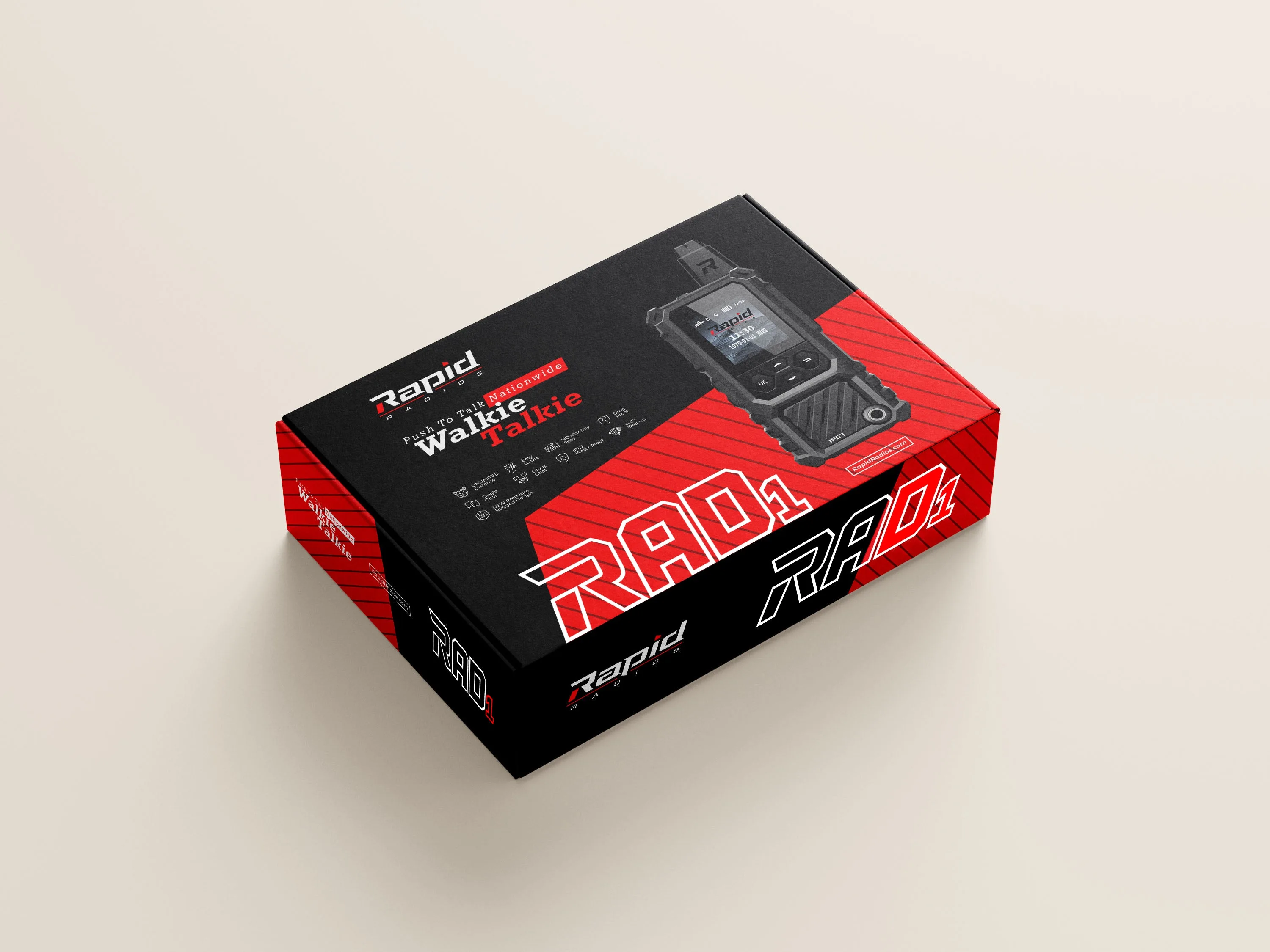
The RAD1 is a compact, waterproof PTT radio built around a standard walkie-talkie form factor. The PTT button sits on the left side, the speaker faces front, and the build is rugged enough to handle job site conditions. Waterproofing means you can use it in rain, at construction sites with water, and for activities like kayaking where splashing is constant. It pairs with the Rapid Radios platform and activates to a cellular plan through their service.
Operation is deliberately simple. Turn it on, it connects to the network, and your assigned channel is live. Everyone on the same channel hears your transmissions in real time — no pairing, no syncing, no matching channels manually the way you do on FRS radios. For crews that rotate workers across shifts, that setup simplicity is a real advantage over traditional radios where someone inevitably forgets to match channels.
The value-for-money score reflects the total cost reality. The device itself is competitively priced for the technology. But PoC radios carry a monthly subscription that traditional walkie-talkies don’t. Over 12–24 months, that subscription adds up to more than the cost of a solid FRS pair. It’s not a hidden fee — Rapid Radios is transparent about it — but anyone doing a cost comparison needs to factor that in before buying.
- Unlimited range over LTE — works nationwide
- Waterproof build for outdoor and job site use
- No channel congestion — private group channels
- No FCC license required
- Simple PTT operation — identical feel to traditional radio
- Group size not limited by RF power or terrain
- Monthly subscription adds long-term cost
- Dead in rural areas with no LTE coverage
- Dependent on cellular infrastructure — network outages affect all units
- Customer service response times flagged by multiple buyers
Rapid Radios vs Traditional Walkie-Talkies
| Feature | Rapid Radios (LTE) | Traditional FRS/GMRS |
|---|---|---|
| Range | Unlimited (LTE coverage) | 1–2 miles real-world |
| Monthly cost | Yes — subscription required | None after purchase |
| License needed | No | FRS: no / GMRS: yes ($35) |
| Works without cell coverage | No | Yes — direct RF |
| Channel congestion | No — private server channels | Yes — shared public frequencies |
| Group size | Unlimited | Limited by RF range |
| Works in remote backcountry | Only with cell signal | Yes — always on |
| Battery dependency | Device + network uptime | Device only |
What Rapid Radios Actually Cost Over 12 Months
Most reviews show you the device price and stop there. Here’s the number nobody leads with: the subscription. Rapid Radios is honest about it — but you have to calculate total cost of ownership yourself before you compare them to a $60 GMRS pair.
| Scenario | Hardware cost | Subscription (est.) | 12-month total | 24-month total |
|---|---|---|---|---|
| 1 RAD1 unit | ~$150 | ~$15–$30/mo | $330–$510 | $510–$870 |
| 2-pack RAD1 | ~$280 | ~$30–$60/mo | $640–$1,000 | $1,000–$1,720 |
| Midland GXT1000VP4 (GMRS pair) | ~$65 | $0 | $65 | $65 |
| Retevis RT29 2-pack (GMRS) | ~$178 | $0 | $178 | $178 |
The math is clear: if your use case is satisfied by a GMRS pair — outdoor recreation, camping, family coordination — the LTE subscription doesn’t make sense. Where Rapid Radios wins is when the unlimited range and private channels are genuinely solving a problem that RF radios can’t. A 20-person construction crew spread across a city block? That’s the use case. A family at a ski resort? A $65 GMRS pair covers it. Check the FRS and GMRS frequency guide for a breakdown of what RF radios can actually do before you decide.
How to Set Up Rapid Radios
Setup is faster than most people expect. The RAD1 ships either with a pre-activated SIM or with instructions to activate through the Rapid Radios platform. You power it on, connect to your account, and the unit joins your assigned channel. No frequency programming, no CTCSS codes, no channel number matching.
Adding additional radios to a group means registering each unit under the same account and assigning it to the same channel. For a five-person crew, that’s five units under one account, all on the same channel, communicating instantly across whatever distance your job requires. Traditional radios require each person to manually set the same channel and privacy code — a small friction point that becomes a real frustration on a busy worksite.
The one setup step that trips people up is confirming LTE coverage at your primary location before committing. If you’re running Rapid Radios at a job site in a cellular dead zone, the radios won’t perform. Check your carrier’s coverage map for the specific locations you’ll use them. For buyers who need radio communication specifically in areas with no cell coverage, see the best two way radios guide for RF-based options that don’t need cellular infrastructure.
Who Should Buy Rapid Radios
Construction and facilities crews in urban areas: This is the ideal use case. Large buildings, multiple floors, outdoor-to-indoor communication — RF walkie-talkies struggle in all of these. LTE doesn’t care about concrete walls. If your crew is spread across a job site in a city, Rapid Radios handles what traditional radios can’t.
Event staff and venue operations: Music festivals, stadium events, convention floors — anywhere you have a large group spread across a wide area with good cellular coverage. The unlimited group size and no-congestion channel system beats shared FRS frequencies at crowded events where everyone’s radio is stepping on everyone else’s.
Families or teams spread across a city: If you want to stay in contact with a partner across town or coordinate a group doing different activities in the same city, this beats phone calls for quick updates. The PTT format is faster than typing or waiting for a call to connect.
Emergency trail use where cell coverage exists: Some hikers carry these as a backup for trail sections with LTE. The Appalachian Trail has partial coverage in many sections. But if you’re going deep into wilderness, don’t rely on LTE radios as your primary emergency communication. A rugged traditional two-way radio or a satellite messenger is the reliable choice for true backcountry use.
Frequently Asked Questions
What are Rapid Radios?
Rapid Radios are push-to-talk over cellular (PoC) radios that transmit voice over LTE networks instead of traditional radio frequencies. They look and operate like standard walkie-talkies — press the button to talk, release to receive — but the signal routes through cell towers, giving them nationwide range wherever LTE coverage exists. No FCC radio license is required to operate them.
How do Rapid Radios work?
Rapid Radios use the 4G LTE cellular network to transmit voice as a data packet to a cloud server, which routes it to all other radios on the same channel in real time. Unlike traditional walkie-talkies that rely on direct RF transmission between units, Rapid Radios have no range limit as long as both sides have cellular coverage. No line-of-sight required, and concrete walls don’t block the signal the way they do with RF radios.
Do Rapid Radios require a monthly subscription?
Yes. Rapid Radios require an active cellular plan to function. The device cost covers the hardware only. Monthly subscription pricing varies — check rapidradios.com for current plan rates. Over 12 months, the subscription typically adds $180–$360 per unit on top of the hardware cost. This is the key difference from traditional FRS/GMRS walkie-talkies, which have no recurring costs after purchase.
Do Rapid Radios work without cell service?
No. Rapid Radios depend entirely on LTE cellular coverage. In areas without cell signal — remote wilderness, underground locations, rural dead zones — the radios won’t transmit or receive. This is the fundamental limitation of all PoC radios. For use in areas with unreliable cellular coverage, traditional RF walkie-talkies are a more reliable option since they transmit directly between units with no infrastructure dependency.
Do you need a license to use Rapid Radios?
No FCC radio license is required. Rapid Radios operate over licensed cellular spectrum owned by the carrier — not the unlicensed FRS/GMRS radio bands. You don’t need an FCC GMRS license the way you would with a GMRS-only radio transmitting at higher power. This makes them straightforward to deploy for commercial teams without radio licensing paperwork.
How much do Rapid Radios cost over time?
The RAD1 hardware runs approximately $150 per unit. The monthly subscription adds roughly $15–$30 per unit per month depending on the plan. That puts 12-month total cost at $330–$510 for a single unit — compared to $65–$180 for a quality GMRS pair with no ongoing fees. Over two years, the subscription cost alone typically exceeds the hardware price several times over.
How do you set up Rapid Radios?
Rapid Radios don’t require traditional programming the way GMRS or ham radios do. You activate the unit through the Rapid Radios platform, assign it to a channel (group), and it connects automatically when powered on. Adding users to a group is done through the account dashboard, not by adjusting frequency settings on the device itself. This is significantly simpler than programming traditional business radios.
Are Rapid Radios waterproof?
Yes. The RAD1 is waterproof and built for outdoor and job site conditions. It handles rain, splashing, and exposure to water during construction or outdoor activities. The manufacturer states waterproof without publishing a specific IP rating on the listing — check the current product page for the latest specification before using it in full submersion scenarios. For comparison, IP67 means submersible to 1 meter for 30 minutes.