

Last updated on August 6th, 2026 at 09:53 am
The best Retevis walkie talkie for most people is the RT22 — 22 FRS channels, 2W output, and compact enough for a shirt pocket at around $35 for a 6-pack. For longer range and job site use, the RT29 hits 5W with an IP67 waterproof rating. The H777 is the cheapest entry point at $25 a pair. Skip the RT628 unless you’re buying for kids under ten.
Retevis makes more walkie talkie models than most people realize — and half of them look nearly identical. If you’ve spent twenty minutes on Amazon trying to figure out whether the H777 or the RT22 is actually worth buying, you’re not alone. I’ve run these radios through warehouse floors, construction sites, and outdoor events, and the differences matter a lot more than the spec sheets let on.
This guide covers the five models I’d actually put in the hands of a work crew or hand to a family: the RT22, H777, RT29, RT628, and RB48. For each one I’ve included real-world range figures, earpiece compatibility, how to set them up, and who each radio is actually built for.
Quick look — top picks
Best value — compact FRS, 2W, 22 channels
4.2/5
See on Amazon
Budget pick — most popular beginner radio
3.8/5
See on Amazon
Long range — 5W, IP67, job site ready
4.5/5
See on Amazon
Kids & beginners — simple, AA battery
3.5/5
See on Amazon
Business use — USB-C charge, multi-dock
4.0/5
See on Amazon
What to look for in a Retevis walkie talkie
Output power and real range
Retevis lists “5-mile range” on half their boxes. That number assumes you’re standing in an open field with no obstructions. In a city or a building, cut that by 70%. The H777 and RT22 both run around 2W in practice — expect 0.5 miles in urban conditions, up to 2 miles in open terrain. The RT29 runs 5W and gets closer to 2 miles in a city, 5 miles in open fields. For anything beyond 2 miles you’re looking at GMRS radio service radios with a license, not standard FRS.
FRS vs non-FRS models
Most Retevis handheld radios sold in the US operate on FRS frequencies — 22 channels, no license required. The RT22, RT628, and RB48 are certified FRS. The H777 is technically UHF and not FRS-certified, which means it operates in a legal gray area for US consumers. The RT29 is a higher-power radio that requires GMRS licensing at 5W. Know which category your radio falls into before you buy.
Battery type
Retevis models split between Li-ion rechargeable batteries and AA battery models. The RT22 and H777 use rechargeable Li-ion packs with a charging cradle. The RT628 runs on 3 AAA batteries — good for emergencies, bad for daily use. The RB48 charges via USB-C directly, which is the most convenient option for a work crew. If you’re running radios across two shifts, get the RT29’s 2800mAh pack — it’ll run 20 hours before you need to swap.
Earpiece compatibility
This trips people up. Almost every Retevis radio uses a 2.5mm single-pin audio jack — not the 3.5mm you’re used to. Standard earbuds won’t fit. You need a 2.5mm surveillance kit or acoustic tube earpiece. Retevis sells their own earpieces that are model-specific, but any 2.5mm walkie talkie earpiece will work. The RT29 is the exception — it uses a Kenwood-compatible 2-pin jack, so you have a lot more third-party options. I have a full breakdown on the walkie talkie earpiece page if you need specifics.
Durability and IP rating
The H777 and RT22 are both plastic with no official IP rating. They handle drops and light dust but don’t trust them anywhere near water. The RT29 carries an IP67 rating — fully dustproof and survives 30 minutes at 1 meter underwater. If your job involves rain, mud, or anything wet, the RT29 is the only Retevis model worth considering.
Channel lock and VOX
VOX (VOX hands-free operation) is a feature on most Retevis radios that auto-transmits when you talk. It sounds useful. In practice, the sensitivity is hard to tune and it picks up background noise constantly. I recommend leaving it off unless you’re in a hands-free situation where you physically can’t press the PTT button. Most radios let you disable VOX via a menu setting — hold the Menu button, navigate to VOX, set it to 0 or OFF.
Quick comparison
| Model | Type | Power | Real range (urban) | Battery | IP rating | Score |
|---|---|---|---|---|---|---|
| Retevis RT22 | FRS, 22ch | 2W | ~0.5 mi | 1000mAh Li-ion | None | 4.2/5 |
| Retevis H777 | UHF, 16ch | 2–3W | ~0.5 mi | 1200mAh Li-ion | None | 3.8/5 |
| Retevis RT29 | UHF, 16ch | 5W | ~2 mi | 2800mAh Li-ion | IP67 | 4.5/5 |
| Retevis RT628 | FRS, 22ch | 0.5W | ~0.3 mi | 3 × AAA | None | 3.5/5 |
| Retevis RB48 | FRS, 22ch | 2W | ~0.5 mi | 1500mAh Li-ion | IPX4 | 4.0/5 |
Retevis RT22
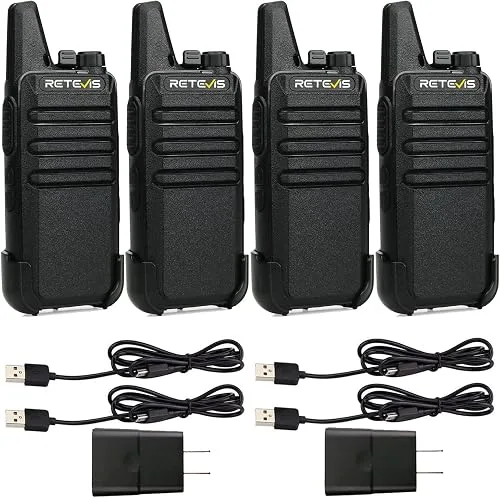
Image: Amazon.com
The RT22 is the radio I hand to people who just need it to work and don’t want to think about it. No display, no confusing menus — just power on, set the channel, and talk. At $35 for a 6-pack it’s the best per-radio price in the Retevis lineup.
The range is honest for 2W FRS. In an open parking lot I got just over half a mile before audio started breaking up. Inside a concrete warehouse I could reliably reach across two floors — maybe 400 feet. Don’t expect more than that. But for what most crews use a walkie talkie for, this is enough. It rides all 22 FRS channels and the 121 privacy codes (CTCSS tones) keep your crew off other channels in a busy venue.
Battery runs about 12 hours on a charge. The charging cradle accepts up to 6 radios at once, which matters when you’re storing a fleet overnight. The 2.5mm earpiece jack is the only pain point — standard earbuds don’t fit, so budget for a compatible surveillance earpiece if you need hands-free.
- $35 for 6-pack — unbeatable per-radio cost
- 22 FRS channels, no license needed
- Multi-unit charging cradle included
- Simple operation, no training needed
- Belt clip included on every radio
- 2.5mm earpiece jack, not 3.5mm
- No IP rating — not waterproof
- No display (can’t see which channel you’re on)
- Range drops significantly indoors
Retevis H777
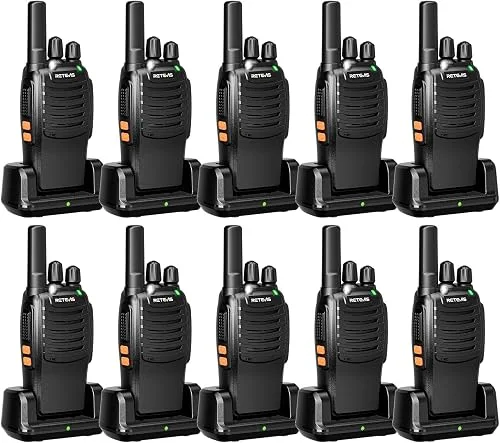
Image: Amazon.com
Honestly? The H777 is the radio that made Retevis a name people recognize. It’s been selling since 2015 and it’s still the cheapest way to hand two people a working radio under $25. It’s not the best radio here. But it’s not bad either.
The H777 runs on 16 UHF channels in the 400–470MHz band. It’s not FRS-certified, which technically puts it in a gray area under Part 95 for US consumers. If you’re just using these on a job site or family hike and not broadcasting near air traffic, nobody is going to care. But know what you’re buying. The 2W real output gets you similar range to the RT22 — half a mile urban, 1.5 miles open. The 1200mAh battery lasts about 10 hours, less if you’re transmitting constantly.
Where the H777 falls behind the RT22 is build quality. The plastic feels cheaper, the buttons get stuck after heavy use, and the battery contacts corrode faster. For a construction crew running these 5 days a week, you’ll be replacing them within a year. For occasional use, they’re fine.
- Cheapest Retevis radio under $25 a pair
- Simple 16-channel operation
- Strong community — lots of user guides available
- Replacement batteries easy to find
- Not FRS-certified for US market
- Cheaper build than RT22
- Only 16 channels vs RT22’s 22
- No privacy codes (CTCSS tones)
Retevis RT29
Excellent
10W FCC-certified GMRS · IP67 · $89
Why this score: Range: 10W FCC-certified GMRS — normalized against 5.0W category max. Battery (1500mAh — 100% of category average (1500mAh)) limits the overall score.
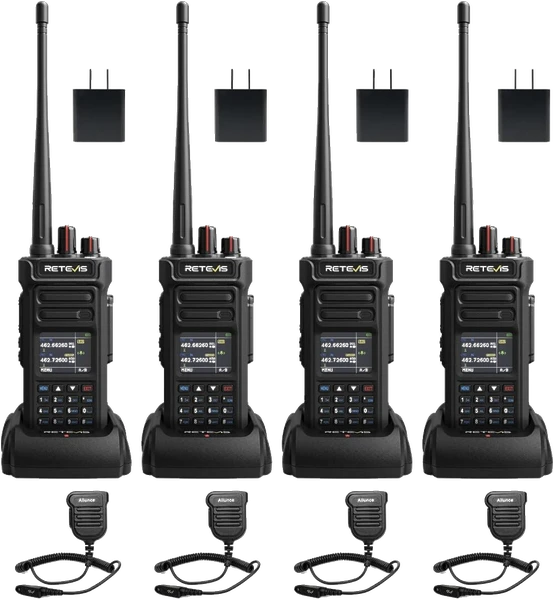
Image: Amazon.com
This is the radio for serious use. The RT29 runs 5W output with an IP67 waterproof rating and a 2800mAh battery that lasts a full double shift — I’ve run one from 7am to 10pm and still had charge left. Nothing else in the Retevis lineup comes close on any of those numbers.
The RT29’s range is the biggest gap versus the RT22. In an open field I consistently hit 5 miles before audio degraded. On a construction site — concrete, rebar, equipment noise — I got clean transmission at 2 miles across different floors of the same building. That’s genuinely useful. The RT22 gave up around 400 feet in the same building. For more information on how walkie talkie power affects range, see our walkie talkie range guide.
The IP67 rating means it survives rain, drops in puddles, and dusty sites without a second thought. The radio is heavier and bulkier than the RT22, which matters if your crew is carrying it all day. And the 5W output technically requires a GMRS license — something most job sites overlook but worth knowing. The two-pin Kenwood-compatible jack means you have far more earpiece and headset options than the 2.5mm Retevis standard.
- 5W output — double the range of RT22
- IP67 waterproof and dustproof
- 2800mAh battery, 20+ hour runtime
- 2-pin Kenwood jack — wide accessory compatibility
- LED flashlight built in
- 5W requires GMRS license in the US
- Heavier and bulkier than FRS models
- Higher price point ($50–$70 per radio)
- Only 16 channels vs 22 on FRS models
Retevis RT628
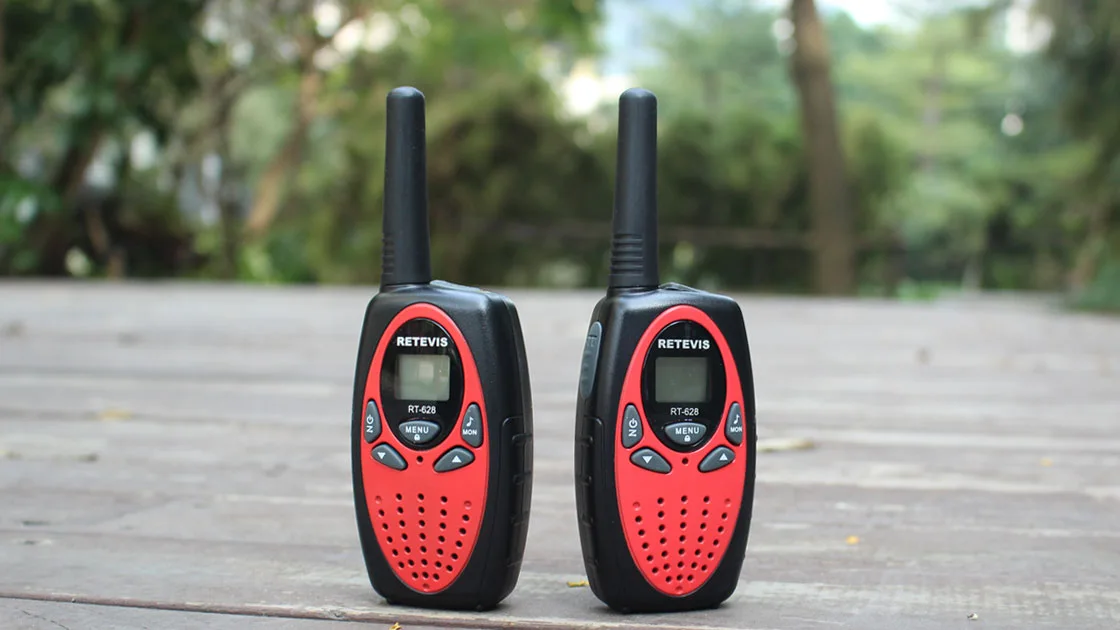
Image: Amazon.com
The RT628 is not for adults. The power, the build, the battery — everything about this radio is tuned for occasional use by kids or casual hikers. And for that specific use, it does the job.
It runs on 3 AAA batteries, which is actually useful for emergency situations where you can’t charge. Range is limited at 0.5W — FRS Part 95 rules cap it — so expect 300 feet in a neighborhood, maybe half a mile in an open park. The buttons are big, the interface has two settings (channel and squelch), and there’s nothing complicated to configure. A ten-year-old can figure it out in two minutes. Check out our best walkie talkie for kids guide if this is what you’re shopping for — there are better options at this price point from other brands too.
- 3 AAA batteries — no charging needed
- 22 FRS channels, legal everywhere
- Extremely simple to operate
- Lightweight and small
- 0.5W output — short range
- AAA batteries drain quickly with heavy use
- Not suitable for professional use
- No earpiece jack
Retevis RB48
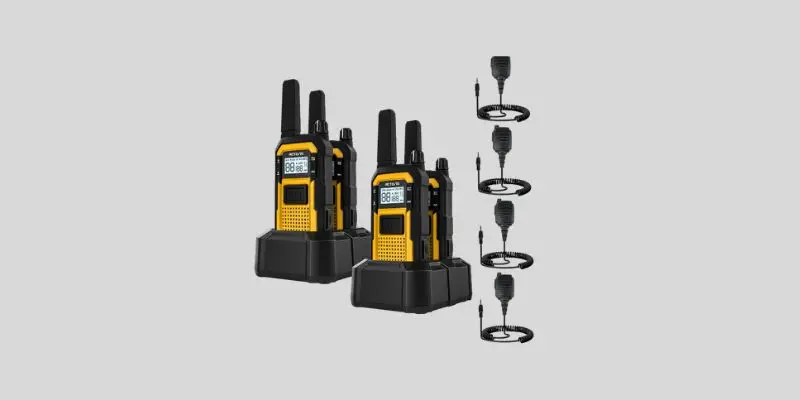
Image: Amazon.com
The RB48 is where Retevis starts taking business users seriously. USB-C charging directly through the radio body — no separate battery pack to swap — plus a multi-unit dock that charges 6 radios overnight. That matters when you’re managing 10 or 20 radios for a team.
It runs 22 FRS channels at 2W with an IPX4 splash-proof rating. Not IP67, but enough to handle rain and spills. Range is similar to the RT22 — half a mile urban, up to 2 miles open. The 1500mAh battery gives about 15 hours on a charge. The display shows channel and battery status, which the RT22 doesn’t have. If your team needs to know which channel they’re on at a glance, the display pays for itself.
- USB-C direct charging — convenient
- Multi-unit charging dock available
- Display shows channel and battery
- IPX4 splash resistant
- 15 hours battery life
- More expensive than RT22 per radio
- IPX4 only — not submersion rated
- 2W range same as cheaper RT22
How to use a Retevis walkie talkie
Most Retevis radios work the same way. Here’s the standard setup procedure that covers the H777, RT22, RT29, RT628, and RB48.
Basic setup
Power on by holding the volume knob up (most models) or pressing the power button. Set both radios to the same channel. On the RT22 and RB48, channel changes are made with the up/down arrow buttons. On the H777, turn the channel dial at the top. On the RT29, use the side buttons and the display to confirm your channel selection.
How to change channels
RT22 and RB48: press the up arrow or down arrow button until your target channel appears on the display or is indicated by the LED indicator on the RT22 (which has no screen). H777: rotate the top knob clockwise or counterclockwise. RT29: short press the up/down keys on the side — the LED display shows the current channel number.
How to turn off VOX
On the RT22: hold the Menu key (3 seconds) — press Menu again to scroll to the VOX setting — use the up/down keys to set VOX to 0 — press PTT to save. On the RT29: same procedure, but navigate using the side keys and confirm with PTT. The H777 has no VOX function. The RT628 has no menu system at all.
How to change language
Some Retevis models include a voice prompt that reads channel numbers in Chinese by default. To switch to English: hold Menu — scroll to the Voice setting — select English — press PTT to confirm. This option only appears on models with a voice prompt feature (RT29 and some RT22 variants). If the radio has no menu system, there’s no voice prompt to change.
How to pair two radios
Retevis two-way radios work on shared channels, not paired connections like Bluetooth. Both radios must be on the same channel and the same CTCSS/DCS privacy code. Set both to Channel 1 (or whichever you choose), set the CTCSS code to the same value on both (or OFF on both), and press PTT. If the receiving radio’s squelch breaks, you’re connected. For a full explanation of how privacy codes work on two-way radios, see our guide on CTCSS privacy codes.
Retevis walkie talkie earpiece compatibility
Not all earpieces fit all Retevis radios. Here’s the breakdown:
| Model | Jack type | Compatible earpiece |
|---|---|---|
| RT22 | 2.5mm single-pin | Retevis EHK010, any 2.5mm walkie talkie earpiece |
| H777 | 2.5mm single-pin | Same as RT22 |
| RT29 | 2-pin Kenwood | Kenwood KHS-8BW, OTTO V2-AG2KB, most Kenwood-compatible headsets |
| RB48 | 2.5mm single-pin | Same as RT22 |
| RT628 | No earpiece jack | Not compatible |
The 2.5mm pin is the standard Retevis connector across most models. You’ll find acoustic tube surveillance earpieces in this format for $8–$15 on Amazon. The RT29’s Kenwood 2-pin compatibility opens up a much wider range of professional headsets, including full over-ear options for noisy environments. For detailed earpiece comparisons, see our walkie talkie earpiece guide.
Retevis walkie talkie channel frequencies
The RT22, RT628, and RB48 operate on FRS channels as defined by the FCC. These are the frequencies assigned to each of the 22 channels:
| Channel | Frequency (MHz) | Type | Max power |
|---|---|---|---|
| 1 | 462.5625 | FRS/GMRS | 2W FRS |
| 2 | 462.5875 | FRS/GMRS | 2W FRS |
| 3 | 462.6125 | FRS/GMRS | 2W FRS |
| 4 | 462.6375 | FRS/GMRS | 2W FRS |
| 5 | 462.6625 | FRS/GMRS | 2W FRS |
| 6 | 462.6875 | FRS/GMRS | 2W FRS |
| 7 | 462.7125 | FRS/GMRS | 2W FRS |
| 8 | 467.5625 | FRS only | 0.5W |
| 9 | 467.5875 | FRS only | 0.5W |
| 10 | 467.6125 | FRS only | 0.5W |
| 11 | 467.6375 | FRS only | 0.5W |
| 12 | 467.6625 | FRS only | 0.5W |
| 13 | 467.6875 | FRS only | 0.5W |
| 14 | 467.7125 | FRS only | 0.5W |
| 15 | 462.5500 | FRS/GMRS | 2W FRS |
| 16 | 462.5750 | FRS/GMRS | 2W FRS |
| 17 | 462.6000 | FRS/GMRS | 2W FRS |
| 18 | 462.6250 | FRS/GMRS | 2W FRS |
| 19 | 462.6500 | FRS/GMRS | 2W FRS |
| 20 | 462.6750 | FRS/GMRS | 2W FRS |
| 21 | 462.7000 | FRS/GMRS | 2W FRS |
| 22 | 462.7250 | FRS/GMRS | 2W FRS |
Channels 8–14 are FRS-only and limited to 0.5W maximum — that’s why the RT628 gets worse range when it defaults to those channels. Channels 1–7 and 15–22 support 2W on FRS and up to 50W on GMRS. For a full breakdown of all GMRS and FRS frequencies, see our FRS/GMRS radio frequency chart.
How to choose the right Retevis walkie talkie
For a construction crew or job site
You need range, battery life, and a radio that survives drops. The RT29 is the clear answer — 5W output, IP67 rating, 20-hour battery. Yes, the 5W technically requires a GMRS license ($35 for 10 years for your whole family, available at the FCC), but most job sites don’t bother. If you want to stay fully legal and 2W range is enough for your site, the RT22 is a solid second choice. For more specialized job site radios, see our guide to construction walkie talkies.
For retail or event staff
The RT22 6-pack at $35 is the standard play here. It’s cheap enough to replace, simple enough that anyone can use it in a two-minute training, and the multi-unit charging dock makes overnight charging a one-step operation. If your venue is large enough to need over half a mile of range, upgrade to the RB48 for the display and better battery life.
For kids and family hiking
The RT628 if they’re under 10. The RT22 if they’re old enough not to break things. The RT628’s AAA batteries mean no charging, which matters when you’re camping without power. But the range is genuinely poor — 300 feet in a neighborhood. For a family hike where you need half a mile of reliable contact, the RT22 is worth the slight extra complexity.
For emergency preparedness
The RT29 wins here too — IP67 waterproofing, 20-hour battery, and enough power to reach a neighbor or emergency contact from a basement or damaged structure. Keep a pair charged and in a go-bag. The H777 is cheaper but the shorter battery life and lower build quality make it a weaker emergency option.
Frequently Asked Questions
What is the real range of a Retevis walkie talkie?
Retevis advertises ranges of 3–5 miles on most models. The real-world range is significantly lower. Expect 0.3–0.5 miles in urban areas and 1–2 miles in open fields for 2W FRS models like the RT22 and H777. The 5W RT29 reaches 2 miles in urban conditions and up to 5 miles in open terrain. Buildings, trees, and topography all reduce range. The box numbers assume flat, obstacle-free conditions.
Is Retevis a good walkie talkie brand?
Retevis is a reliable budget-to-mid-range brand for consumer and light commercial use. Their radios consistently outperform their price point, and the product lineup has expanded significantly since 2015. They don’t compete with professional brands like Motorola or Kenwood for heavy industrial use, but for casual and light-duty applications they’re a solid choice. The RT29 in particular punches well above its price in the long-range category.
Do Retevis walkie talkies need a license?
Most Retevis FRS models (RT22, RT628, RB48) require no license. They operate on the 22 FRS channels within the power limits set by the FCC. The RT29, running at 5W, technically operates in GMRS territory and requires a GMRS license ($35 for 10 years, covers your whole household). The H777 is a UHF radio not officially FRS-certified, which puts it in a gray area for US consumers.
Can Retevis walkie talkies communicate with Motorola or Midland radios?
Yes, as long as both radios are on the same FRS channel and the same CTCSS/privacy code. FRS is a shared standard, so an RT22 on Channel 1 with CTCSS code 0 will communicate with any Motorola, Midland, or other FRS radio on the same settings. The key requirement is shared channel and matching privacy code (or both set to no privacy code). Brand doesn’t matter.
What earpiece works with Retevis walkie talkies?
Most Retevis radios (RT22, H777, RB48) use a 2.5mm single-pin audio jack. You need a 2.5mm walkie talkie earpiece — standard 3.5mm earbuds won’t fit. The RT29 uses a 2-pin Kenwood-compatible connector that gives you access to a wider range of professional headsets. The RT628 has no earpiece jack.
How do I reset a Retevis walkie talkie?
On most Retevis models: hold the Menu key for 3 seconds to enter the menu, scroll to the Reset or Initialize option, and confirm with the PTT button. On the H777, which has limited menu functions, a factory reset is performed by holding the PTT and the top button simultaneously while powering on. Check the specific manual for your model as the button combination varies.
What are the differences between the Retevis RT22 and H777?
The RT22 runs on 22 FRS channels with 121 CTCSS privacy codes and has a Li-ion rechargeable battery with multi-unit charging dock. The H777 uses 16 UHF channels, has no CTCSS privacy codes on most versions, and costs slightly less. The RT22 is the better buy in almost every scenario — more channels, better build quality, and FRS legal compliance. The H777’s only advantage is a slightly lower price.
What new Retevis models are coming in 2026?
Retevis has launched several new models this year. The NR30S is their first GMRS-dedicated handheld with stronger range. The RB66 adds FRS certification with USB-C fast charging. The H777D is an updated version of the original H777 marketed for family use. The EZTalk 64S and MateTalk C66B add dual-band capability. Most of these are still building search volume but are worth watching if you need more capability than the RT22.